Hymenocallis caribbean
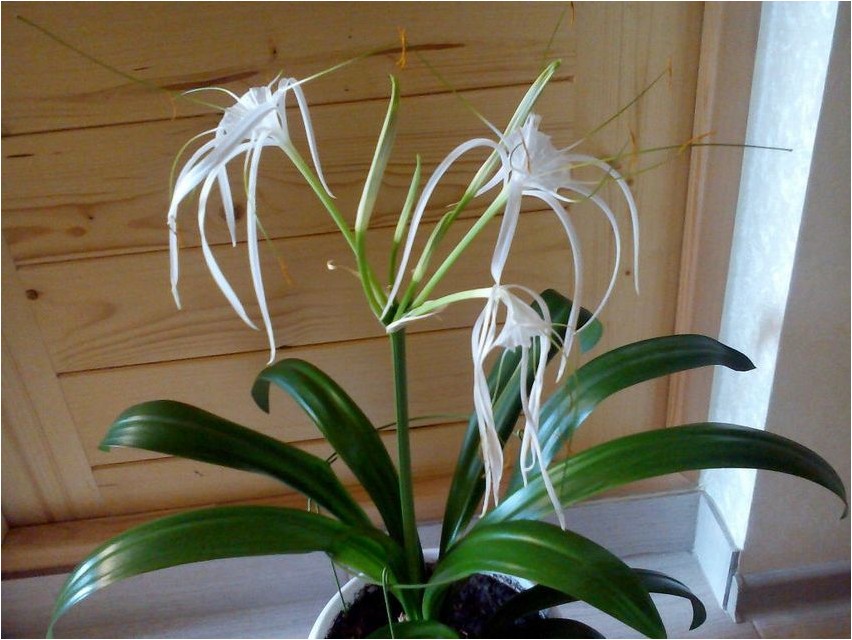
Hymenocallis caribbean is also known as Ismene and Pancratium. The Latin name for this plant is Hymenocallis caribaea.
This plant belongs to the Amaryllidaceae family, and its Latin name is Amaryllidaceae.
Description of Hymenocallis caribbean
Hymenocallis caribbean is a bulbous plant. Extra caution should be exercised when handling this plant, as all parts of the Hymenocallis caribbean are poisonous. This plant is recommended for growing in many conservatories, hallways, and offices. It also looks beautiful in group plantings in containers. If you are growing Hymenocallis caribbean indoors, it is recommended to choose bright rooms. It is worth noting that if the plant is grown on a south-facing window, it will require some shade. For this reason, Caribbean Hymenocallis is most often grown on east- or west-facing windowsills.
As for its maximum height in cultivation, this plant can reach up to one meter.
Description of Care and Cultivation Features
For optimal growth, Caribbean Hymenocallis requires regular repotting, which should be done approximately every three to four years. For this, standard-sized pots should be used: for a mature bulb, such pots should be approximately fifteen to twenty centimeters in diameter. The following soil composition should be chosen: one part loam and sand, and three parts leaf mold. The acidity of this soil should be slightly acidic.
It is important to remember that both overwatering and drying out the soil can be detrimental to this plant. If the soil mixture is overwatered, the lower leaves will first begin to yellow, followed by a brown coloration and a water-soaked appearance.

It’s worth noting that novice gardeners often confuse this plant with the hippeastrum, leading to improper care and cultivation methods. To avoid confusion, remember that the leaves of the Hymenocallis are almost flat, with a pointed tip. The leaves of the hippeastrum are grooved, with a slightly rounded tip. In some cases, this plant can be attacked by scale insects or spider mites.
During the entire dormant period, the Caribbean Hymenocallis requires a temperature of approximately sixteen to eighteen degrees Celsius. Regarding watering, the plant requires moderate watering. When growing indoors, the dormant period is forced. This dormant period lasts several months: it begins in October and ends in February. This dormant period occurs when air humidity and light levels are insufficient. Hymenocallis caribbeanis propagates through bulblets and also by sowing seeds.
The plant has a fairly robust root system, so it requires a fairly spacious pot. It’s best to place Hymenocallis caribbeanis in a bright room, but avoid excessively hot temperatures. Fertilizing with organic fertilizers is not recommended, as this can cause bulb rot.
A WINDOW SILL MIRACLE – HYMENOCALLIS.