Parrotia
Parrotia (lat. Parrotia) is a monotypic genus of trees of the Witch Hazel family. The only representative of the genus is Persian Parrotia (lat. Parrotia persica).
Other names are ironwood, iron ore or ambur. Botanically, parrotia is similar to witch hazel. The plant received its name in honor of the naturalist Johann Parrot. Parrotia appears on one of the postage stamps of Azerbaijan. In this country she is a kind of symbol.
Characteristics of crops
Parrotia is a highly branched deciduous tree up to 30 m high with a broadly ovoid crown and a short trunk reaching a diameter of 1. 5 m. The wood is dense, durable, and heavy. The branches are smooth, olive green, often pubescent, and tend to grow together. The buds are stalk-shaped, spindle-shaped, covered with brown scales. The leaves are dark green, asymmetrical, petiolate, elliptical or obovate, up to 12 cm long, pubescent, pointed at the tips.
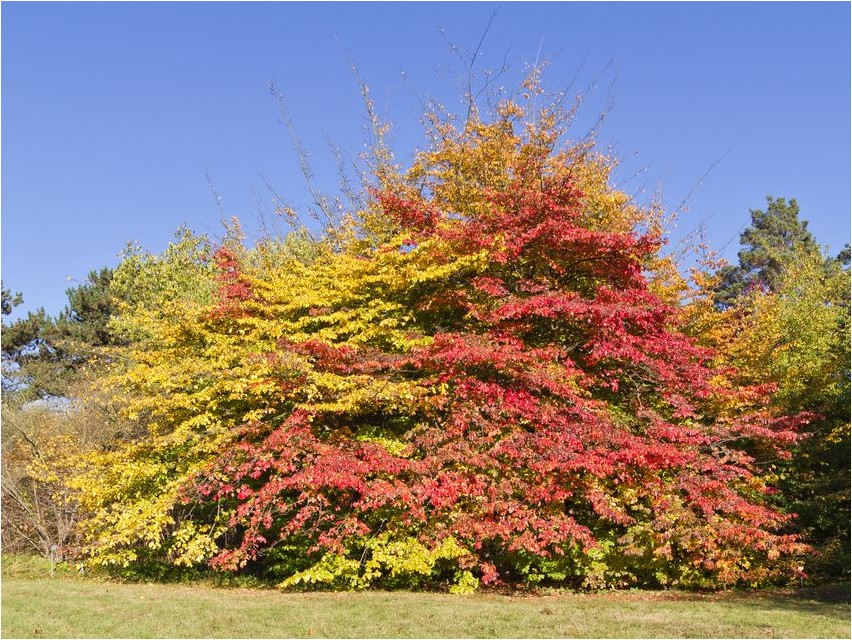
In autumn, the foliage turns yellow, orange, brown, purple and even red. The leaves do not fall for a long time, sometimes until mid-winter. The flowers are inconspicuous, petalless, with a 5-7-petalled calyx, collected in capitate inflorescences of 2-5 pieces. The fruits are small, oval, and when ripe they open with two doors. The seeds are sharp, ovoid, and shiny. Parrotia blooms in March-April, the fruits ripen by October. The average age is 180-200 years.
Distribution and application
Currently, the culture is found in the relict forests of Azerbaijan and Iran near the Caspian coast. Parrotia is a supporter of warm temperate and subtropical climates. It often grows in the mountains, but not higher than 700 m above sea level; along streams and rivers and other wet places. In Europe, parrotia is used as an ornamental crop; it is easy to cut and shape. In Russia, plants are extremely rare, although they can withstand frosts down t o-25C. Parrotia wood is used to make frames, joinery, ax handles, floorboards, etc.
Subtleties of cultivation
Parrotia prefers well-drained, slightly acidic, podzolized soils. Accepts calcareous, slightly alkaline soils with added organic matter. When growing crops in containers, the soil mixture is made up of fertile soil and peat. The location is sunny or partially shaded. Dense shadow is undesirable. In shaded areas, the color of parrotia foliage is less intense.

Reproduction
Parrotia is propagated by seeds and layering. Seeds are sown in September-October (immediately after collection) in an unheated room under cover in the form of peat or humus. Entries appear within 1-1. 5 years. Grown seedlings are transplanted into separate containers and grown indoors. Parrotia, obtained by sowing seeds, is planted in a permanent place after 4-5 years.
Reproduction of parrotia by layering is not prohibited. To do this, the lower shoots are slightly cut and buried in the soil. With the appearance of a well-developed root system, the cuttings are separated from the mother plant and planted in the ground. As a rule, complete rooting occurs after 1. 5-2 years.
Care
Care comes down to regular and moderate watering, annual fertilizing with complex mineral and organic fertilizers, weeding and loosening of the tree trunk area. Feeding is carried out at least 2-3 times a year. Sanitary pruning is mandatory; this procedure involves removing diseased, broken and frostbitten branches. For the winter, only young specimens need shelter.
Parrotia is extremely rarely affected by pests and diseases, but this only applies to those regions where climatic conditions are optimal for the normal existence of plants. With high humidity and dense shade, spots appear on the leaves, which are formed due to the adverse effects of fungi.