Heteropappus setospilosus
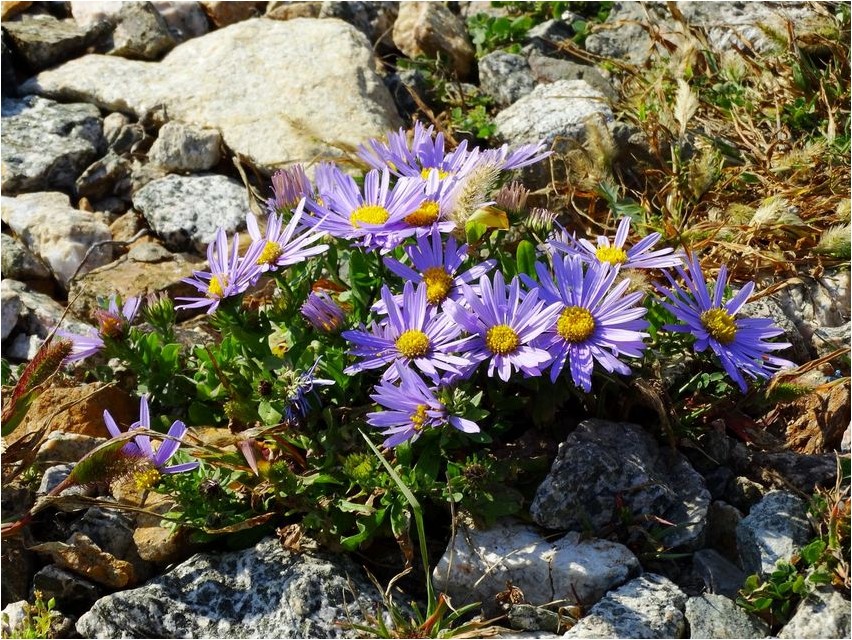
Heteropappus setospilosus is a member of the Asteraceae family. Its Latin name is Heteropappus hispidus (Thunb.) Lees.
The family name of Heteropappus setospilosus is Asteraceae Dumort.
Description of Heteropappus setospilosus
Heteropappus setospilosus is an annual or biennial plant with a thin, slightly fibrous root. The stem is erect, reaching 30 to 100 centimeters in height, finely furrowed, and densely foliated. The basal leaves of this plant fall early and are oblanceolate, blunted at the top and tapering immediately at the base into a winged petiole. These leaves will have spaced, serrated edges and are ciliated, dark green above and lighter below.
The middle leaves of Heteropappus setosus will be either linear or oblanceolate, tapering below, and tapering along the edges or sparsely serrated, as well as somewhat curled. These leaves may have either curved hairs or be stiffly hairy. It is noteworthy that the upper leaves of this plant gradually become smaller. The flowers of this plant are borne in capitula on fairly long peduncles, which are covered with bracts. The peduncles will be densely or curly hairy, and are borne in broad corymbs. The bracts of Heteropappus setospilosa are bilinear, nearly identical in shape and herbaceous, and can be either linear-lanceolate or rhomboid-lanceolate. The receptacle is somewhat conical, the disc florets are approximately five to seven millimeters long, the styles are elongated at the ends, and the ray florets are white. The fruit of this plant is an achene, compressed dorsally, and approximately two and a half to three millimeters long. The pappus of the marginal florets of Heteropappus setospilosa is white and approximately two and a half millimeters long.
It is noteworthy that the discs of the flowers of this plant are bristly, and from the outer to the inner flowers such bristles will gradually lengthen. They will be either dark brown or reddish in color. The length of such flowers of Heteropappus bristulosa will be about three and a half to four millimeters, and they will also be drawn upward. This plant blooms from June to October.
For growth, Heteropappus bristulosa prefers rocky and sandy cliffs, as well as pebbles. Under natural conditions, this plant can be found in the Russian Far East; as for its general distribution, Heteropappus bristulosa can be found in Mongolia, China, Japan and Korea.

Description of the medicinal properties of heteropappus bristulosa
Heteropappus bristlecone is endowed with quite valuable healing properties, and it is recommended to use the roots of this plant for medicinal purposes. Such roots of this plant should be harvested from spring to autumn. It is recommended to dig up the plant, and then the roots should be separated from the stem, after which they are well washed and dried.
It should be noted that in Chinese medicine this plant is quite widespread. In China, a powder based on the crushed root of this plant is used: this product is used as a powder for purulent abscesses and poisonous insect bites.