Gentiana septemfida
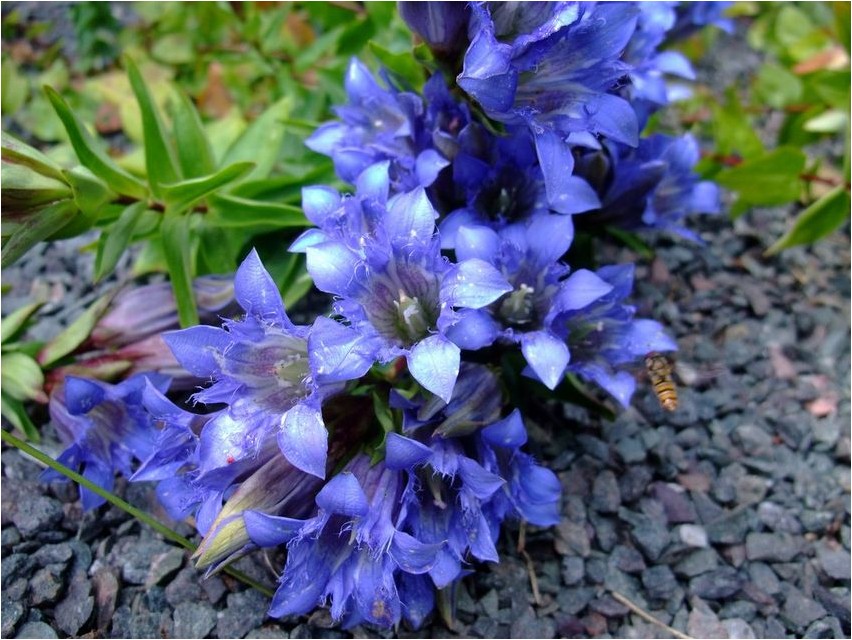
Gentiana septemfida is a member of the Gentianaceae family. Its Latin name is Gentiana septemfida Pall.
The family name of Gentiana septemfida is Gentianaceae Juss.
Description of Gentiana septemfida
Gentiana septemfida is a perennial herbaceous plant, growing between ten and fifty centimeters in height. Its rhizome is thick and bears cord-like roots. Gentiana septemfida stems are numerous, ascending or straight, with brown scales at the base and dense foliage above. The plant’s leaves are sessile, ranging from ovate to lanceolate, approximately two to five centimeters long and less than one centimeter wide. These leaves are fused in pairs into a sheath. The flowers are twisted at the very top of the stem.
The calyx is bell-shaped, approximately eighteen to nineteen millimeters long, and notably, half the length of the corolla. The corolla is dark blue, with ovate lobes and fringed folds, half the length of the lobes themselves. Gentiana heptaparta blooms in the second half of summer.
In the wild, this plant can be found in the Caucasus, the Baltic region, and, quite rarely, in European Russia. Gentian heptatidis prefers forest edges, meadows, forest clearings, cliffs, and rocky and gravelly slopes in both mid- and high-altitude zones.
Description of the medicinal properties of Gentian heptatidis
Gentian heptatidis has quite valuable medicinal properties, and the herb and roots of this plant are recommended for medicinal purposes.

These healing properties are explained by the presence of flavonoids, alkaloids, and phenylcarboxylic acids in the plant. The leaves of this plant contain not only carbohydrates but also their related compounds: fructose, sucrose, glucose, vitamin C, gentiobiose, and gentianose. Experiments have shown that a dry extract of the rhizomes and dried herb can increase salivation and exhibit vasodilatory, hypotensive, choleretic, hemostatic, and anticoagulant effects. In fact, preparations based on this plant are recommended for use as an analogue of yellow gentian. Experiments have also shown that the herb extract and the flavonoids can exert a hypotensive effect.
In folk medicine, a decoction of the herb of gentian heptatidis is used for malaria, as well as as an appetite stimulant and digestive aid. It is noteworthy that a decoction of this herb also exhibits antibacterial activity. For gastritis accompanied by decreased secretion, the following remedy is effective: To prepare it, take three tablespoons of crushed dried gentian heptapartite herb and two cups of water. Boil this mixture for about three minutes over fairly low heat, then let it steep for one hour. Then strain the resulting mixture thoroughly. It is recommended to take this remedy, approximately one-quarter to one-third of a glass, three times daily before meals. If all instructions for use are followed, this remedy will produce very effective results.
Gentian heptapartite in an alpine garden (video)