Sweet honeysuckle
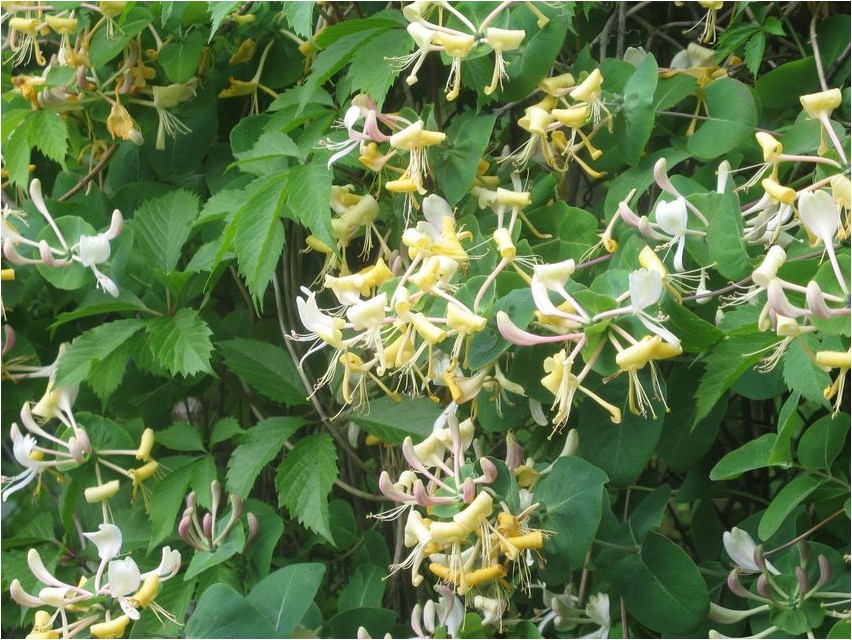
Fragrant honeysuckle is one of the plants of the family called honeysuckle; in Latin the name of this plant will be as follows: Lonicera caprifolium L.
As for the name of the fragrant honeysuckle family itself, in Latin it will be: Caprifoliaceae Juss.
Description of honeysuckle
Fragrant honeysuckle is also known under the following names: goat honeysuckle, variscuda and honeysuckle. Fragrant honeysuckle is a perennial and highly branched shrub, endowed with a climbing trunk, the height of which will be about four to six meters. The branches of this plant are covered with bark colored in dark or grayish-brown tones. The leaves are either obovate or ovate, the leaves are dark green on top and bluish to whitish underneath. The length of such leaves will be three to ten centimeters, and the width will be two to six centimeters. The leaves of one or two upper pairs will grow together at fairly wide bases into a rounded plate. Fragrant honeysuckle flowers are collected in whorls of three to ten pieces. The corolla consists of fragrant flowers, painted in whitish or yellowish tones; often such flowers can be endowed with a tube painted pink or red.
Flowering of fragrant honeysuckle occurs in the period starting from May and ending with the first half of July, as well as in the month of July-August. The fruit of this plant is a red berry endowed with several seeds. Under natural conditions, the plant can be found in the Caucasus and Crimea. It is noteworthy that in Ukraine the plant is grown as an ornamental. For growth, the plant prefers places along the edges and banks of streams, in broad-leaved forests, as well as in fairly bright places where the soil is well moistened. Plants are found from the lower to the upper strip of the forest belt; fragrant honeysuckle will grow singly or in groups.
Description of the medicinal properties of honeysuckle
Fragrant honeysuckle is endowed with very valuable healing properties. The flowers of this plant contain essential oil.
The plant is endowed with wound-healing, anti-inflammatory, analgesic and diuretic effects. Fresh flowers of this plant are used in homeopathy in the form of alcoholic essence. It is noteworthy that the plant has been proven to have antiviral activity against the tobacco mosaic virus. A decoction of the leaves of this plant is used externally as a gargle for a variety of throat diseases.

For dermatoses, it is recommended to use fresh leaves and their juice. Also, the juice of fragrant honeysuckle leaves is also effective for malignant ulcers. An infusion of flowers can be used as a diaphoretic, diuretic and expectorant. For eye diseases, an aqueous infusion of the flowers of this plant is used as a lotion. Freshly crushed leaves of honeysuckle should be applied to wound surfaces, which will promote rapid healing of wounds.
It is recommended to drink a decoction or infusion of the leaves and stems of this plant for gastrointestinal colic, and you can also wash your hair with this decoction to avoid continued hair loss.
For throat diseases, it is recommended to use the following mouthwash: to prepare this remedy, take one tablespoon of crushed dry leaves per glass of water. The resulting product should be boiled for four to five minutes, and then left to infuse for an hour, after which it is filtered very carefully.





