Multi-tiered onion
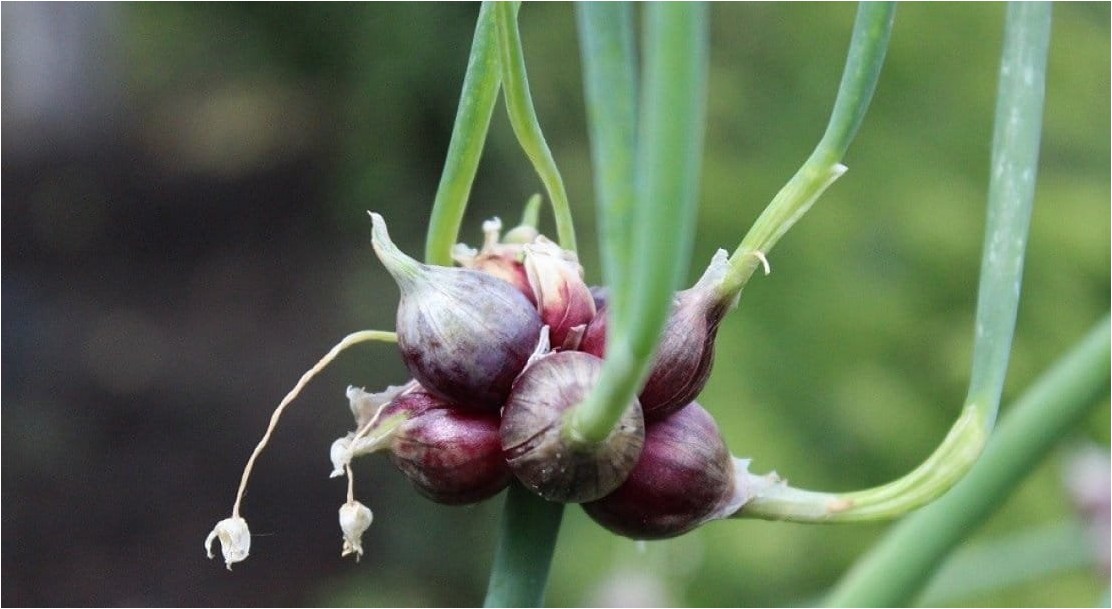
Multi-tiered onion (lat. Allium proliferum) is a perennial plant of the Allium family (Alliaceae). Hybrid of Allium cepa and Allium fistulosum.
Multi-tiered onions are considered to be vegetable crops suitable for growing in early spring. The exact place of origin of this variety of onion is not known for certain; it is likely that its homeland is China, from where the plant came to Europe in the Middle Ages. In Russia, the plant is known under the names Canadian onion, horned onion, viviparous onion, Egyptian onion, catawissa.
Characteristics of culture
Multi-tiered onion is a herbaceous plant that is a close relative of the spring onion and differs from it in the structure of the flower arrow. The leaves are dark green with a waxy coating, hollow, tubular, wide, up to 20 cm long. The inflorescence is located on a tubular arrow up to 1 m high, which subsequently forms aerial bulbs. As a rule, up to 2-4 levels of flower arrows with 3-30 aerial bulbs are formed. The root system is powerful and, subject to optimal growing conditions, grows strongly, for this reason it needs thinning.
Multi-tiered onions are characterized by increased cold resistance; they can winter without shelter even a t-50C without any problems. Young leaves can withstand frosts down t o-7C. It can grow in the same place for 5-6 years. It has a negative attitude towards sudden temperature changes; with prolonged early spring thaws and subsequent frosts, onions die. Multi-tiered onions begin to grow quite early, usually 7-10 days earlier than spring onions.
Growing conditions

Sites for growing multi-tiered onions are preferably well-warmed, early cleared of snow cover and cleared of perennial rhizomatous weeds. Soils are desirable fertile, light, moderately moist. Plants do not tolerate acidic and heavy clay soils. The best predecessors are cucumbers, cabbage, zucchini, potatoes, beets and legumes.
Reproduction and planting
Multi-tiered onions are propagated by aerial bulbs (bulbs), root bulbs and dividing the bush. The area for the crop is prepared in the fall: the soil is dug up, rotted compost, superphosphate and any potash fertilizer are added. Acidic soils require preliminary liming; on heavy soils, coarse sand is added for digging. Aerial bulbs are planted in the ground in an ordinary way at the end of August — beginning of September. This planting period ensures 100% survival and rooting. The distance between plants should be 10-12 cm, and between rows — 20-25 cm.
In spring, multi-tiered onions are propagated by dividing the bush. The bush is divided into several parts and immediately planted in the ground in rows with an interval of 24-25 cm. Often, crops are propagated by root bulbs that form in plants in the second year after planting. It is preferable to plant after rain, in which case the bulbs immediately begin to actively develop.
Care
Caring for multi-tiered onions consists of the following procedures: weeding, watering, fertilizing and thinning. After the snow melts, perennial plantings are fed with urea and treated with Epin Extra solution. This approach increases resilience in stressful situations. After two weeks, the plants are sprayed with Ferovit solution to enhance the process of photosynthesis. The first thinning is carried out when the plants reach 25 cm, in the future — as necessary. After each cutting, multi-tiered onions are fed with nitrophoska and treated with Tsitovit solution.
Water the plants 3-4 times per season at the rate of 10-15 liters per 1 square meter; in case of prolonged drought, the number of waterings is increased. Onion arrows are thin and unstable; under the weight of airy bulbs they lie down or break, so the plants need to be tied to trellises. As you know, the root system of a crop grows quickly, usually by 3-4 years. If it was decided to leave the onion in the same place for a longer period, thinning is carried out. 2-3 basal bulbs are left in one nest, the remaining bulbs are used as planting material for forcing or for food purposes.