Dichorisandra regal
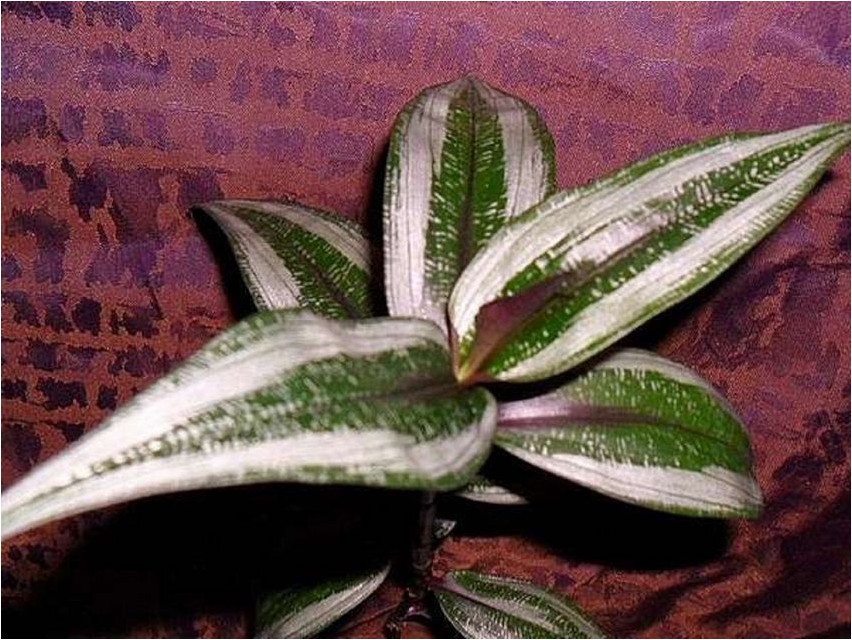
Dichorisandra regalis is one of the plants of the family called Commelineaceae. In Latin, the name of this plant is as follows: Dichorisandra reginae.
As for the name of the family of this plant itself, it will be like this: Commelinaceae.
Features of care and cultivation of royal dichorisandra
The plant will need to provide either a sunny light regime or a partial shade regime. Throughout the summer period, the plant will need to be provided with abundant watering, and the air humidity at this time should be kept at an average level. The life form of royal dichorisandra is a herbaceous plant. This plant is quite often found in winter gardens, as well as indoors. When growing in rooms, choose either western, or eastern, or even southern windows for plants. However, if grown on southern windows, the plant will need to be provided with slight shading. In addition, the royal dichorisandra is also grown as an hanging plant, either in hanging baskets or in wall planters, and the plant can also act as a ground cover crop in flowerpots in which rather large plants grow: for example, such as other dracaenas or ficuses.
In cultivation, the maximum height of the shoots of this plant can reach from forty centimeters to one meter. The plant requires either annual repotting or repotting once a year. This is due to the fact that the root system of the plant is rather weak. Royal dichorisandra should be replanted in rather wide, but shallow pots. It is recommended to deepen the rhizome of the plant into the soil by about two to three centimeters; thanks to this circumstance, the formation of taller and stronger shoots will be stimulated.
As for the composition of the soil mixture, you will need to prepare the following soil: one part each of turf soil and sand, as well as two parts leaf soil. Soil acidity can be either neutral or slightly acidic. It should be remembered that the roots of this plant will react extremely negatively to overdrying of the soil mixture. In addition, this plant ages quite quickly, and the decorative value of the royal dichorisandra is also lost. For this reason, it is recommended to perform short anti-aging pruning once every two to three years. A replacement for such pruning can also be annual pinching of plant shoots.
During the autumn and also winter, the leaves of this plant may turn yellow and fall off. The plant itself should be kept almost completely dry throughout this time, and in the spring, watering the plant should be carefully resumed. In the event that the air humidity is below sixty percent, the royal dichorisandra can also be affected by spider mites.

Throughout the entire dormant period, it will be necessary to ensure that the plant grows at an optimal temperature of approximately sixteen to twenty degrees Celsius. Watering at this time should be quite rare, and air humidity should be kept at an average level.
Reproduction of royal dichorisandra most often occurs through cuttings. To do this, you will need to position the top of the shoot, on which there are leaves, vertically, and in addition, position the lower part of the shoot horizontally. In this case, the cutting itself should be covered with soil about one to two centimeters. It is noteworthy that sometimes plant propagation occurs by dividing the bush, as well as by sowing seeds.
It is important to remember that direct sunlight, as well as low air humidity, can greatly affect plant development. Especially during periods of active growth, air humidity should be maintained at around seventy to seventy-five percent.