Schlumbergera
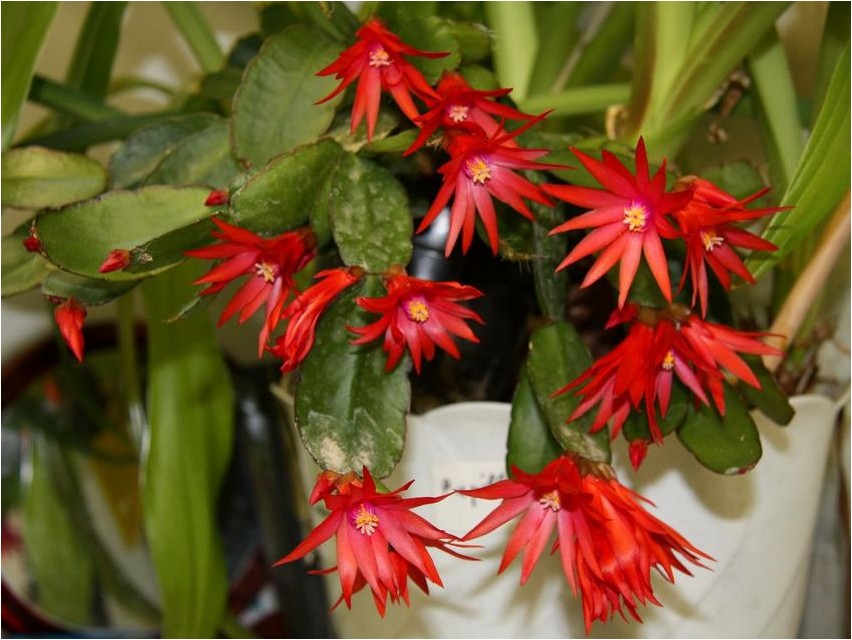
Schlumbergera (Latin: Schlumbergera) is a small genus of cacti that live in the wild on trees or rocks. It belongs to the tribe Rhipsalideae, which belongs to the subfamily Cactaceae of the family Cactaceae.
According to some sources, there are only six species in the genus. Most Schlumbergera species, instead of the usual leaves, have stems that resemble leaf-like pads connected to each other, and flowers that emerge from the joints of these pads or are born at the ends of the stems. What’s in a name?
The genus Schlumbergera owes its name to the French plant taxonomist Charles Antoine Lemaire (November 1, 1800 – June 22, 1871). It is believed that Lemaire dedicated the name to the Frenchman who continued the cacti collection begun by his father. This man’s name was Frédéric Schlumberger (April 19, 1823 – February 18, 1893). However, due to different spellings of the surname in various printed sources, which differ by only one letter, other versions of the people bestowed this honor have arisen. Regardless, Frederic Schlumberger is most often cited.
Plants of the genus have many common names. In Brazil, the genus is called “Flor de Maio” (“May Flower”) because it blooms in May. Since in the Northern Hemisphere, plants prefer to bloom in winter, people call them “Decembrist,” “Thanksgiving Cactus,” or “Christmas Cactus.”
Description
In the wild tropical forests of southeastern Brazil, plants of the genus Schlumbergera grow on robust tropical trees or on the cliffs of coastal mountains, where humidity is typically high and shady enough for epiphytic cacti to thrive, obtaining food and moisture from the air. Their appearance is very different from their spiny desert relatives in the Cactaceae family.
Most species in the genus have stems resembling leaf-like cushions, connected to each other by narrow nodes. Two species more closely resemble other cacti, with cylindrical, succulent stems.
If in most terrestrial plants the photosynthetic organ is the leaves, then in plants of the genus Schlumbergera this role is performed by the stems. The stem pads or segments take one of two shapes. The first form, characteristic of most species of the genus, is highly flattened segments (the so-called cladodes), consisting of a central core with 2-3 “wings”. At the ends of the segments, special structures called “areolas” are formed. In the second form, the stems are less flattened, closer to the shape of a cylinder, and the “areoles” are located not at the ends of the segments, but along the entire segment more or less in a spiral. Both forms necessarily have “areolas” at the site where the flower bud appears and may have hair or bristles.

Flowers are born at the junctions of leaf-shaped pads, or are located at the ends of the stems, emerging from the “areola”. They can be drooping towards the surface of the ground or window sill in indoor plants, or located more or less horizontally. The color of the flowers has a fairly rich palette, including white, yellow, pink, orange, purple or red. Each flower is composed of 20-30 petals. Closer to the base of the flower there are unconnected short outer petals. The inner petals are located towards the tip of the flower. They are longer than the outer ones and gradually become more fused at the base, forming a floral tube. In some species, the difference between the inner and outer petals gives the appearance of a “flower within a flower.”
For plants of the genus Schlumbergera, a distinctive feature is the double-row arrangement of numerous stamens, which gives the flowers a special charm.
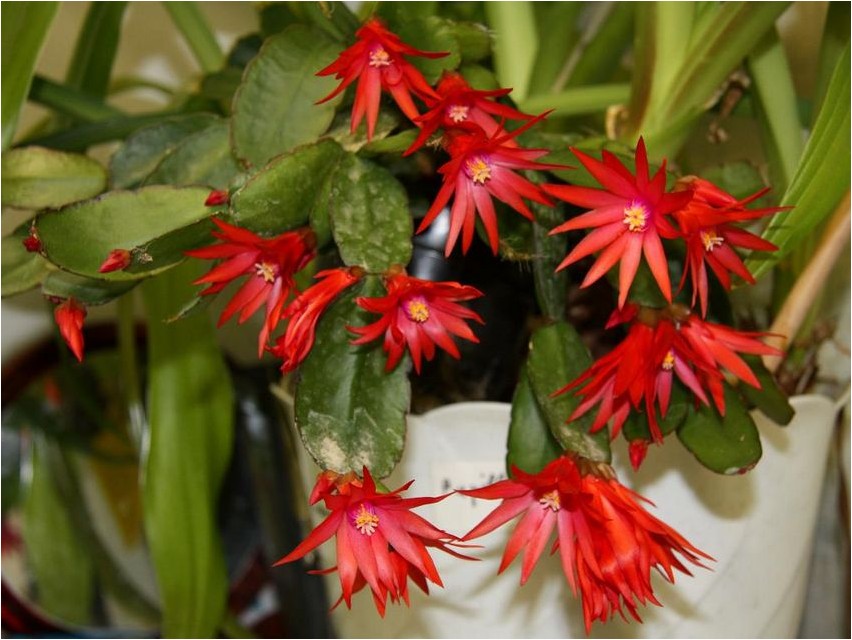
Fertilized flowers turn into black or brown seeds up to one millimeter in diameter.
Schlumberger home care