Granadilla yellow
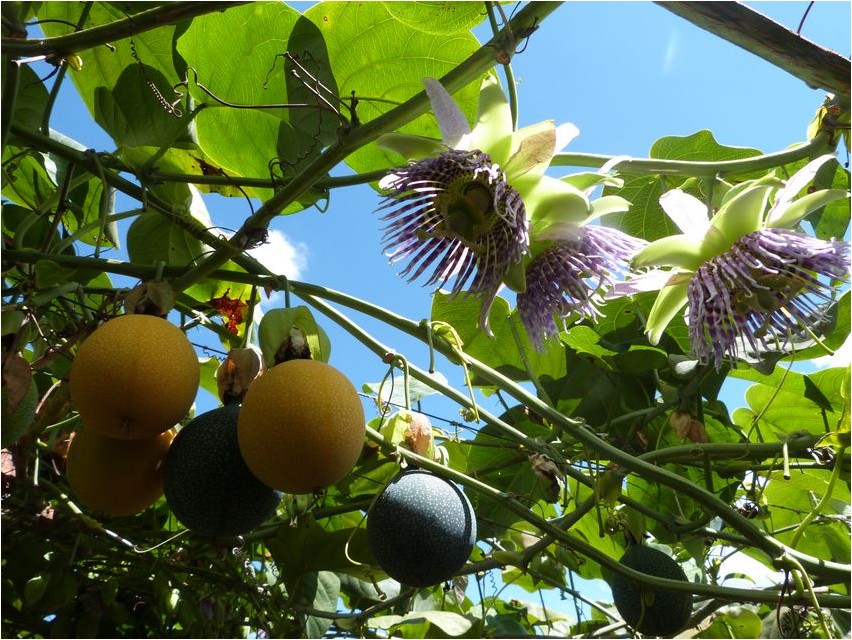
Yellow granadilla (lat. Passiflora laurifolia) is a fruit plant from the Passionflower family. It is often called passionflower laurel.
Description
Yellow granadilla is a deciduous perennial vine, endowed with weaving tree-like stems with rather rigid yellow tendrils that help it cling to established supports. And its height often reaches ten meters.
The oval, leathery and glossy leaves of the plant are slightly pointed at the tips and grow from 3. 4 to 8 cm in width and from fifteen to twenty centimeters in length.
The fruits of this crop are also oval. They are all edible and grow up to five to eight centimeters in length and four to six centimeters in width. And this culture owes its name to the orange-yellow color of its fruits. The translucent white pulp of these amazing fruits is incredibly fragrant and juicy, with a pleasant sweet taste, and inside the fruits there are a great many fancy flat seeds.
Where does it grow
Most often, this culture can be found in tropical America. In culture, yellow granadilla is cultivated in Venezuela and French Guiana, as well as in the Antilles (Puerto Rico, Barbados, as well as Jamaica, Cuba and the territory of Trinidad from Haiti), Peru and Guyana. It is also grown in Suriname and Colombia. In the eighteenth century, this culture was introduced to Malaysia, and then to Hawaii and Ceylon, as well as to South Vietnam, India and Thailand.
Application
In most cases, yellow granadilla is consumed fresh. Having made a small hole at one end of the fruit, slowly suck out its contents along with the seeds. True, yellow granadilla is preserved just as often, the juice is squeezed out of it, and the pulp is also added to all kinds of dessert dishes.

These fruits boast quite a significant amount of vitamin C, which makes them an excellent antiscorbutic remedy. They are no less useful for all kinds of gastrointestinal ailments. Thanks to these delicious fruits, you can cope with asthma, dysentery, migraine, neurasthenia, lack of appetite and insomnia.
And the peels of the fruit are an excellent source of pectin, widely used to make delicious marmalade and jams. Roots with leaves are also used — from them local residents prepare an effective anthelmintic. A decoction of seeds is an excellent sedative (calming) agent, while its more serious dosages can also be used as a sleeping pill. By the way, yellow granadilla seeds are very rich in valuable oil, of which they contain up to twenty percent.
Contraindications
These aromatic fruits have no special contraindications; just don’t forget about possible allergic manifestations or individual intolerance.





