Tuevik
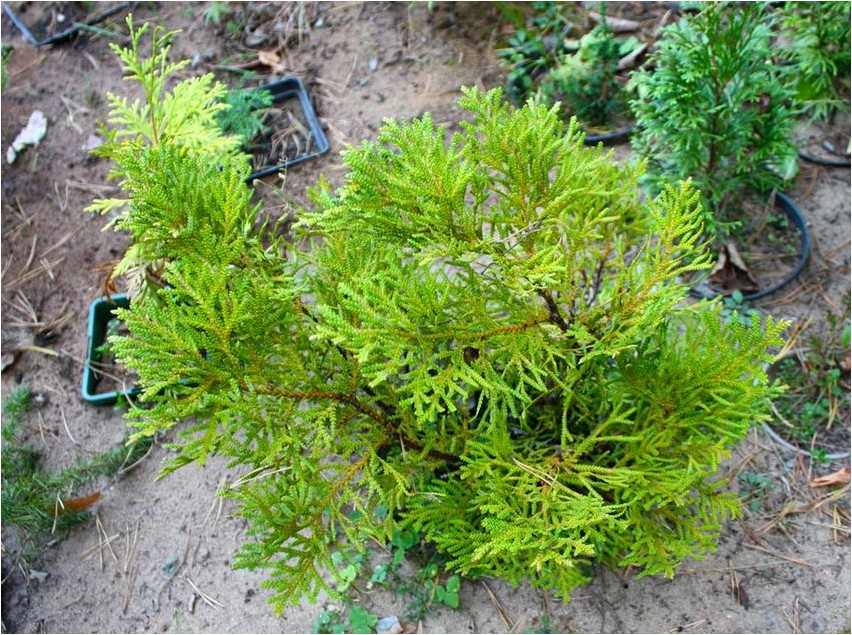
Tuevik (lat. Thujopsis) is a genus of evergreen coniferous trees of the Cypress family. The only representative of the genus is the drooping tuevik, or chisel-shaped tuevik (lat. Thujopsis dolabrata).
Previously, the Japanese thuja (lat. Thuja standishii) was included in the genus. The natural range is the Japanese islands (Honshu, Hokkaido, Shikoku and Kyushu). Today, thuevik is grown in many European countries, in parks and gardens of the Black Sea coast and in Azerbaijan.
Characteristics of culture
Tuevik is an evergreen coniferous shrub or tree with a dense pyramidal crown and wide flat branches drooping at the ends. The bark is reddish-brown, peeling off in narrow strips.
The needles are dark green, shiny, scale-like, thick, outwardly reminiscent of thuja needles, but have a slightly “synthetic” appearance. The needles are very aromatic, which is why the plant is used to obtain essential oils used in the perfume industry.
The cones are woody, round, up to 15 mm in diameter, equipped with 6-10 scales. The seeds are winged, up to 7 mm long. In Japan, arborvitae are divided into two subspecies: southern and variegated. Both types are decorative, the differences between them are minor.
Growing conditions
Tuevik develops well in open sunny areas and in partial shade. Soils are preferably moist, loamy, fresh, fertile, well-drained with a pH of 4. 5-8.

The crop is relatively drought-resistant, but the presence of moisture in the soil is desirable; prolonged drying out of the soil should not be allowed. Tuevik has a negative attitude towards waterlogged, saline and swampy soils.
Reproduction
Tuevik is propagated by seeds, cuttings and grafting. Thuja occidentalis is used as a rootstock. The properties and characteristics of the mother plant are most accurately reproduced by specimens grown by sowing seeds. However, this method is not always feasible, so gardeners most often propagate the crop by cuttings.
Cuttings are cut in the summer, the percentage of their rooting is 70-80%. Before planting for rooting, cuttings must be treated with growth stimulants. Arborvitae are propagated extremely rarely by layering, since the plants do not retain the pyramidal crown shape typical of the culture. Mature plants propagated in this way are unsightly, with crooked branches that cannot be molded.
Arborvitae seedlings are planted in the spring. The distance between plants should be 0. 5-1. 5 m. The depth of the planting hole is preferably 60-70 cm, width 50-60 cm. A drainage layer of 10-15 cm is laid at the bottom of the hole, then 1/3 of the substrate is added, consisting of turf soil, sand and peat compost in a ratio of 3:2:2 and a slide is formed. It is also recommended to add 200-300 g of nitroammophoska, which must be thoroughly mixed with the soil mixture. When planting, the roots are straightened, the root collar is placed at the level of the soil surface.
Care
Feeding is carried out once every two years. For these purposes, it is not forbidden to use complex mineral fertilizers, including Kemiru-universal. Arborvitae are watered only during prolonged drought. Young plants need regular watering. Water consumption per adult tree is 8-10 liters. In autumn, the soil in the tree trunk zone is dug up to a depth of 25-30 cm, after which it is watered and mulched with peat or wood chips in a layer of 5-7 cm.
Formative pruning for arborvitae is desirable, as well as sanitary pruning. The latter consists of removing dry and frozen branches. Seedlings planted in late autumn are covered with fabric film or glassine for the winter. Materials can be fixed on specially installed frames, but so that they do not come into contact with the plants.
Usage
Tuevik looks harmonious in group and single plantings. It goes perfectly with cypress, oak, larch, fir, pine, spruce, cryptomeria and beech. Arborvitae wood is used in construction, as well as in shipbuilding, because it is resistant to decay and has a very pleasant aroma.