Clivia cinnabar
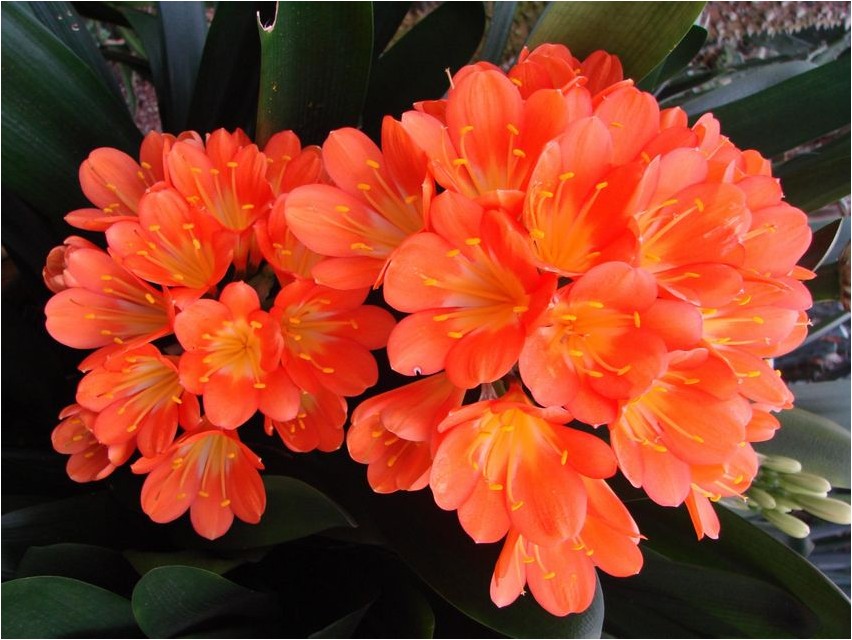
Clivia cinnabar is also known as the orange lily and also as the house lily. In Latin, the name of this plant will be: Clivia miniata.
Clivia cinnabar is one of the plants of the family called amaryllidaceae, and in Latin the name of this family is as follows: Amaryllidaceae.
Description of Clivia cinnabar
It is worth noting that this plant can hardly be called particularly demanding to care for. In the summer, Clivia cinnabar will require moderate watering, and air humidity should be kept at an average level. As for the light regime, not only the sun will be acceptable, but also partial shade. The life form of Clivia cinnabar is a rhizomatous plant.
This plant can often be found in numerous winter gardens, as well as in general purpose premises: for example, in offices and lobbies. As for growing clivia cinnabar indoors, preference should be given to both western and eastern windows. The maximum size of this plant can be about sixty centimeters.
Description of the features of care and cultivation of Clivia cinnabar
In order for Clivia cinnabar to always please you with its appearance, it is recommended to regularly replant this plant. For such a transplant, pots of standard proportions or slightly wider containers are required. As for the composition of the soil mixture itself, this will require mixing one part of turf soil and sand, as well as two parts of leaf soil. The acidity of such soil should be either neutral or slightly acidic.
It should be noted that excessive moisture is extremely undesirable for the favorable development of Clivia cinnabar: otherwise, browning of the tips of the leaves of this plant may occur. In the case where there is a lack of nutrition, the leaves will begin to become paler, and new shoots will not appear. As already mentioned, this plant is not particularly demanding to care for, however, among the possible pests of Clivia cinnabar, mealybugs and scale insects should be noted.

During the dormant period, the plant will require a temperature range between ten and fifteen degrees Celsius, and one should not forget about moderate watering. The dormant period of Clivia cinnabar begins in October and continues until February. Such a dormant period will be forced if this plant is grown indoors, and the reasons for its occurrence are low air humidity and insufficient lighting.
Propagation of Clivia cinnabar rarely occurs through seeds, which are obtained through artificial pollination. In addition, propagation of this plant can also be done by separating root suckers.
After the peduncle reaches about ten centimeters in length, Clivia cinnabar should be provided with fairly abundant watering, however, waterlogging of the soil will be extremely undesirable. It is recommended to cut off the faded peduncle and those ovaries that appear after the end of the flowering period.
The flowers and leaves of Clivia cinnabar are endowed with decorative properties. The length of the leaves of this plant can reach even sixty centimeters, while their width does not exceed six centimeters. These leaves will be dark green in color and have a rounded tip. At the same time, there are also types of this plant that will be endowed with longitudinal stripes of white or yellow color.