St. John’s wort elongated
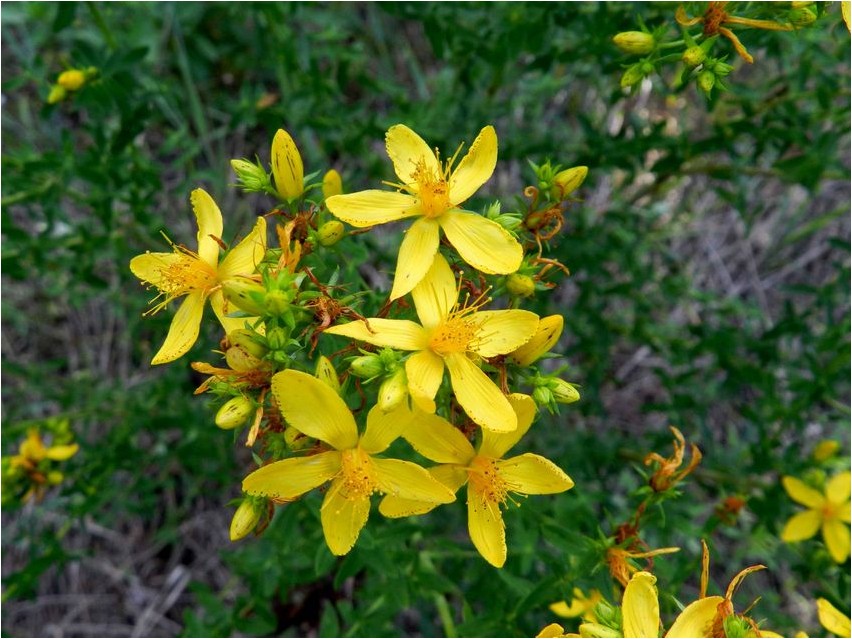
St. John’s wort is one of the plants of the family called St. John’s wort; in Latin the name of this plant will be as follows: Hypericum elongatum Ledeb.
As for the name of the St. John’s wort family itself, in Latin it will be like this: Hypericaceae Juss.
Description of St. John’s wort
St. John’s wort is a perennial herbaceous plant whose height ranges from twenty to fifty centimeters. The stems of this plant are quite numerous, rarely they are single, such stems are bare and they are colored in tones from bluish-green to brown. The leaves will be quite oblong, they can be either broadly linear or lanceolate. The leaves are endowed with transparent glands, the inflorescences of this plant are racemose-paniculate, the flowers are numerous, they are colored either golden yellow or whitish. The fruit of St. John’s wort is an ovoid, long-pointed capsule, brownish-brown in color. The seeds will be cylindrical in shape, they are white-haired, brown in color and two to two and a half millimeters long.
Flowering of St. John’s wort occurs during the period from May to July. Under natural conditions, this plant is found in the Crimea, in Western Siberia in the Altai and Irtysh regions, as well as in Central Asia and the Caucasus. For growth, the plant prefers thickets of bushes, dry rocky slopes and steppes in the mid-mountain zone.
Description of the medicinal properties of St. John’s wort
St. John’s wort is endowed with very valuable healing properties, and it is recommended to use the grass and seeds of this plant for medicinal purposes. The term grass includes leaves, flowers and stems. The presence of such valuable healing properties is explained by the plant’s content of vitamin C, carotene, coumarins, tannins, essential oil, quercetin, rutin, hyperin, quercitrin, anthraquinones, anthocyanins, vitamins P and E.
It is noteworthy that the infusion of the herb of this plant can have an anthelmintic effect. The experiment proved that the herb can increase diuresis by one hundred percent.

As for traditional medicine, St. John’s wort is often used for medicinal purposes. It is recommended to drink an infusion of the herb for stomach ulcers, gastritis, diarrhea, dysentery, diseases of the bladder, kidneys and liver, as well as hemorrhoids and rheumatism. The flowers of this plant can be brewed as tea and drunk for jaundice.
A decoction of the herb St. John’s wort is also used for liver cancer, and is also used to rinse the mouth for bleeding gums. It is noteworthy that the above-ground parts of this plant can be used to dye various fabrics. In scientific medicine, this plant is used along with St. John’s wort. A decoction of the seeds of this plant is used as a laxative and also drunk for malaria.
As a laxative, you can use the following remedy based on St. John’s wort: to prepare such a plant, you will need to take one teaspoon of the seeds of this plant per glass of water. The resulting mixture should be boiled for five to six minutes, and then left to steep for one hour, after which this mixture is filtered very carefully. Take this remedy half a glass or one third of a glass per day on an empty stomach. This remedy can also be used for malaria: for this purpose, drink one tablespoon of the decoction three times a day. It should be noted that to achieve the greatest effectiveness, it is important to comply not only with all preparation standards, but also with all standards for taking this product.





