Zherukha officinalis
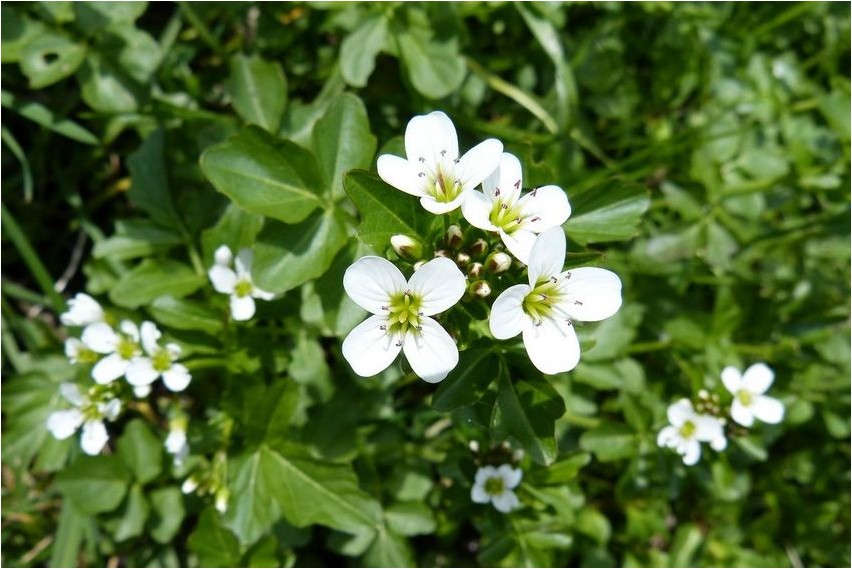
The watercress is one of the plants of the family called cabbage or cruciferous plants; in Latin the name of this plant will be as follows: Nasturtium officinale L.
As for the name of the watercress family itself, in Latin it will be: Brassicaceae Burnett.
Description of watercress
The watercress is a perennial herbaceous plant, endowed with a hollow grooved stem, the height of which is about ten to sixty centimeters. The leaves of this plant are pinnate, they are endowed with five to seven rounded leaves. The flowers of watercress are painted white; they can also be pale pink. Such flowers are collected in a brush. The fruit consists of pods on stalks that stand upward; such fruits are also endowed with flat valves and an awl-shaped style. The length of such a column turns out to be slightly greater than the width of the pod.
Under natural conditions, the plant is found in the European part of Russia, Belarus, Central Asia, Ukraine and the Caucasus. For growth, the plant prefers places along the banks of rivers and swamps, as well as wet meadows. Sometimes the plant can be found simply in water.
Description of the medicinal properties of watercress
The watercress is endowed with very valuable healing properties, and it is recommended to use the juice of this plant and leaves for medicinal purposes. The presence of such valuable healing properties is explained by the content of essential oil, mineral compounds, large amounts of vitamin C, as well as iodine and carotene in the composition of watercress. As for the essential oil, it also contains phenylethyl oil.
In folk medicine, the healing properties of watercress are used for inflammation of the kidneys, various skin diseases, scurvy, anemia, kidney and bladder stones, kidney diseases and as a mild laxative. It is noteworthy that fresh young leaves of this plant can be eaten as a salad.

For eczema, it is recommended to use a fairly effective remedy based on watercress: to prepare such a remedy, you will need to squeeze the juice from the plant. This squeezed fresh juice is taken three times a day, one teaspoon before meals until the desired result occurs.
In addition, another remedy based on watercress is recommended for various skin conditions. To prepare this remedy, take twenty-five to thirty grams of fresh leaves of this plant and steep them for two to three hours in one liter of boiling water. Afterwards, strain the resulting mixture thoroughly. Take one glass of this remedy twice daily. It is important to strictly follow not only the preparation instructions but also the dosage instructions for taking this remedy to achieve maximum effectiveness.
This plant is recommended for skin conditions because it contains a wide variety of beneficial substances. Watercress-based remedies are also used for severe bronchitis, which is accompanied by the production of sputum and pus.
Remedies based on this plant are also used to treat chronic and acute nephritis, scurvy, and anemia. Warts and lipomas are removed with an ointment made from butter and fresh watercress juice. This ointment also helps heal burns. The juice of this plant helps strengthen gums: brush your teeth with it three times a day.





