Glaucium flavum
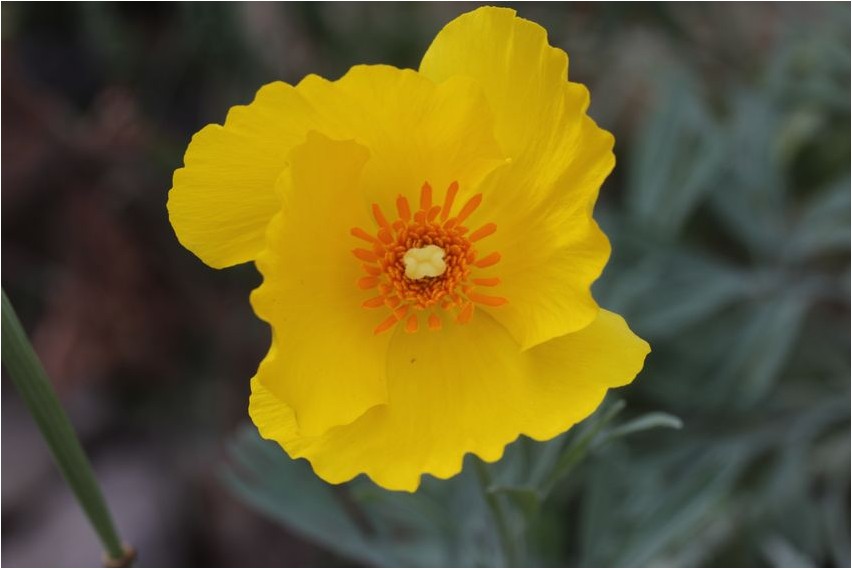
Glacium flavum is a member of the poppy family. Its Latin name is Glaucium flavum Crantz.
The Latin name of the Glaucium flavum family itself is Papaveraceae Juss.
Description of Glaucium flavum
Glacium flavum, also known as yellow poppy, grows to a height of approximately twenty to fifty centimeters. Glaucium flavum is a biennial herbaceous plant with bare, branched stems. Its leaves are thick and very glaucous, while the basal leaves are quite large, densely pubescent, and lyrate-pinnate. The buds of this plant are also bare or slightly needle-like, and are ovoid-oblong and pointed. The bud of this yellow Glacium flower is approximately two to three centimeters long, with petals ranging from yellow to orange, with a reddish or purple spot at the base. These petals are approximately one and a half to three centimeters in diameter. The peduncles of the yellow Glacium flower are short and straight, and their pods are approximately fifteen to twenty-five centimeters long.
The yellow Glacium flower blooms from May to June. In the wild, this plant can be found in the Black Sea region of European Russia, as well as in Crimea, the Caucasus, and the Black Sea region of Ukraine. In the Caucasus, it can be found in the Ciscaucasia and Western Transcaucasia. It prefers rocky, cliff-like slopes and scree, as well as seashores in the littoral zone. This plant is grown on plantations, as it has been introduced into cultivation. Description of the medicinal properties of Glacium lutea
For medicinal purposes, it is recommended to use the herb of this plant, which is recommended to be harvested during stemming and budding, as well as during flowering. In this case, grass should be collected from cultivated plants of both the first and second years of life. The grass of yellow glacium should be dried under a canopy with good ventilation, while the grass is spread in a thin layer on paper or fabric. Glatium yellow contains alkaloids, namely: isocoridine, protopine, aurotensin and glaucine. The roots of this plant also contain alkaloids: magnoflorine, norchelidonine, chelirubine, chelerythrine, protopine, allcocryptopine and sanguinarine.
The herb of this plant will contain mediating alkaloids: isocoridine, glaucine, protopine, sanguinarine, chelerythine, helirubin, allcokryptonine, xinoacutin, methylatheroline, glaucine, isoboldine, resins, mineral salts, magnoflorine and dimethylglaucine. Glacium flavum leaves will contain quercetin, sanguinarine, as well as the following phenolcarboxylic acids: caffeic and ferulic acids in the hydrolyzate. The seeds of this plant contain fatty oil; it is noteworthy that such oil can be used in food and even for making soap.
It should be noted that the alkaloids of this plant are biologically active substances. For this reason, preparations based on this plant will help fight cough. Also, these drugs are also endowed with pronounced hypotensive, analgesic and antispasmodic effects. Preparations based on Glacium yellow are used as antitussives for the treatment of pharyngitis, bronchitis, lung abscesses and lobar pneumonia, as well as various other respiratory organs.

“Red Book of Kuban”. Maciek yellow





