Macedonian licorice
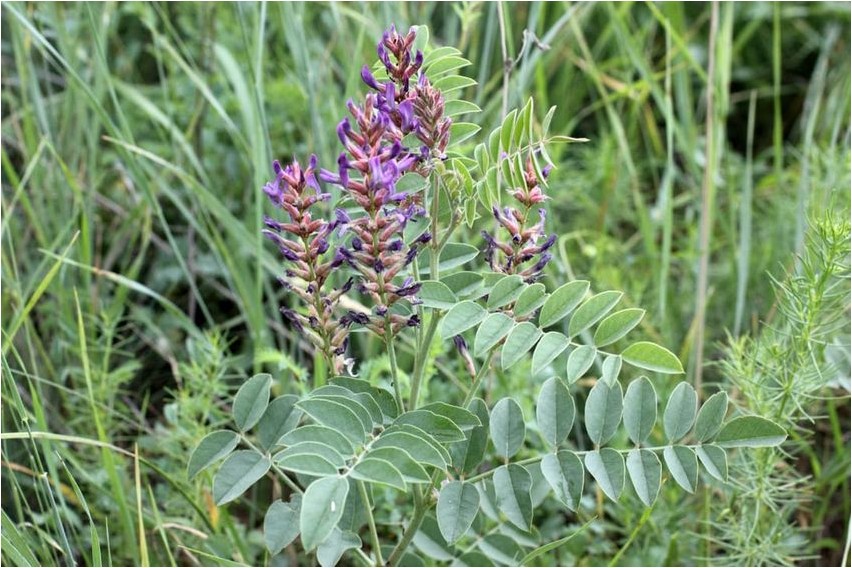
Macedonian licorice is one of the plants of the family called legumes; in Latin the name of this plant will be as follows: Glycyrrhiza foetidissima Tausch.
As for the name of the Macedonian licorice family itself, in Latin it will be: Fabaceae Lindl. (Leguminosae Juss.).
Description of Macedonian licorice
Macedonian licorice is a perennial herbaceous plant whose height will vary between one hundred and one hundred and fifty centimeters. The flowers of this plant are located in rather dense and oblong inflorescences, they are painted in pale purple tones, and their length is about six to seven and a half millimeters. The beans of this plant are oblong-oval in shape, and they will be covered evenly and sparsely through thin spines. It should be noted that Macedonian licorice will be endowed with a rather specific smell both in dry and fresh states.
This plant blooms from June to August. Under natural conditions, Macedonian licorice is found in the Caucasus, Moldova, the European part of Russia, the Volga valley in the Lower Volga region and the Danube valley in the Black Sea region. For growth, Macedonian licorice prefers the edges of fields, ditches, floodplains and banks of oxbow lakes. It is noteworthy that this plant can grow both in sparse thickets and in groups.
Description of the medicinal properties of Macedonian licorice
Macedonian licorice is endowed with very valuable healing properties, and it is recommended to use the roots of this plant for medicinal purposes. The presence of such valuable healing properties should be explained by the content in the roots of this plant of triterpenoids in the hydrolyzate of macedonic, echinic and meristotropic acids, flavonoids, saponins, triterpene glucuronirhamnoside, echinic and macedonic acids, as well as the following organic acids: tartaric, succinic, citric, malic and fumaric acid. In the above-ground part of this plant, in turn, the following flavonoids will be present: astragalin, isoquercitrin, quercetin, kaempferol, nicotiflorin and rutin. The stems and fruits contain organic acids, and the leaves contain the flavonoids nicotiflorin and rutin, as well as the following organic acids: malonic, tartaric, fumaric, succinic, citric, oxalic, malic and gluconic.
It is noteworthy that the experiment proved that echinate, meritotropic and macedonic acid will be endowed with the ability to provide anti-inflammatory effects, and will also exhibit an effect that is similar to glucocorticoid.

A decoction prepared from the roots of Macedonian licorice is indicated for use in cases of Addison’s disease, dry cough, bronchitis, diabetes mellitus, pneumonia and gastric ulcers.
During menopause, it is recommended to use the following very effective healing remedy based on this plant: to prepare such a healing remedy, you will need to take one teaspoon of crushed Macedonian licorice roots in one full glass of boiling water. The resulting mixture should be left to infuse in a thermos for about four hours, after which this mixture must be filtered very carefully. Take the resulting medicinal mixture based on Macedonian licorice half an hour before meals, warm, three to four times a day, one-third of a glass, for about two to three weeks. Then you should take a break for a month, after which you can resume taking this remedy based on Macedonian licorice.





