Sciadopitis
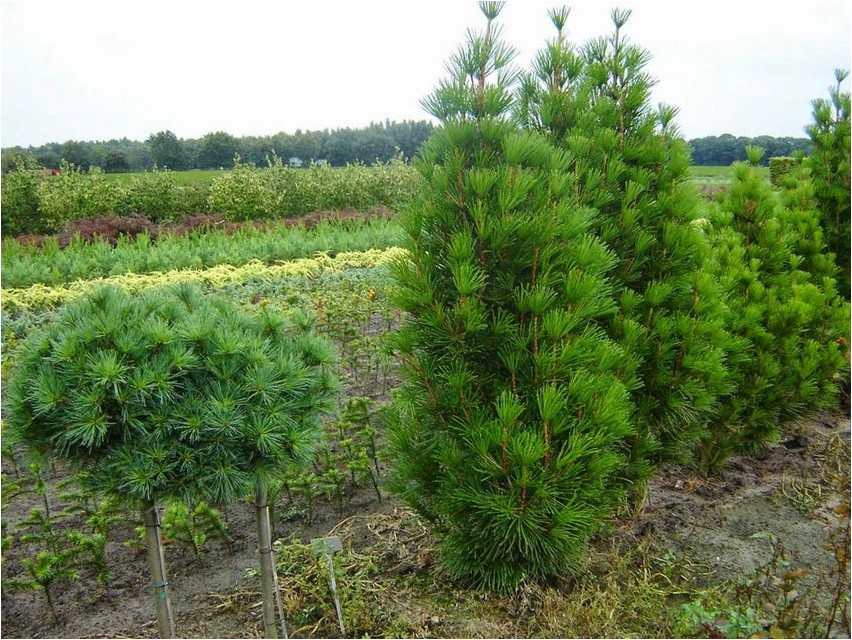
Sciadopitis (lat. Sciadopitys) is a monotypic genus of trees of the Sciadopitis family. Previously, the genus was classified as a member of the Taxodiaceae and Cypressaceae families, but studies have shown that there is nothing in common between Sciadopitis and the families in question.
The only representative of the genus is sciadopitys verticillata. The natural habitat is the mountain forests of Japan; previously sciadopitis was found in nature in Greenland, Yakutia, the Urals and Norway. The genus received its name due to the unusual whorled arrangement of needles, which outwardly resemble the spokes of an umbrella. The name is derived from two Greek words “skias” — umbrella, “pitys” — pine.
Characteristics
Sciadopitis is an evergreen tree up to 40 m high with a slender trunk and a narrow conical or pyramidal crown. Cultivated sciadopitis reach a height of 10-20 m. The bark is quite thin, grayish-brown or gray, smooth, and peels off with age in longitudinal narrow strips.
Sciadopitis is notable for its unusual needles; the needles form false whorls, spread apart into different angles, like the spokes of an umbrella, which is why the plant is popularly called “umbrella pine.” Needles are not real leaves; they are considered to be modified shortened shoots. True leaves are almost invisible, formed at the tips of branches, usually scale-like, brown, up to 4-5 mm long.
Male flowers are located crowded at the ends of the shoots, female flowers are solitary, equipped with scale-like leaves at the base. The cones are brown, blunt, oblong-ovate, up to 10 cm long. The cones ripen 17-18 months after planting, usually do not crumble, and contain winged seeds. Sciadopitis wood is aromatic, resistant to moisture, non-resinous, soft, light, yellow-white in color, often with a reddish tint.
Growing conditions
Sciadopitis is a heat-loving plant, preferring areas well warmed by the sun. Accepts partial shade. Has a negative attitude towards cold winds. The soil for growing crops is desirable to be loose, fertile, drained, moist, fresh, slightly acidic or neutral.

Growing sciadopitis on alkaline soils is possible, but such conditions have a detrimental effect on the development of plants; they often suffer from chlorosis. Loose loamy or sandy-humus soils are optimal for the crop. Mulching is not necessary, but encouraged.
Reproduction
Sciadopitis is propagated by seeds, semi-lignified cuttings and air layering. Freshly harvested seeds are used for sowing. When sowing in spring, seeds need stratification for three months at a temperature of 3-5C. In regions with cold winters, seeds are sown in seedling boxes and grown indoors.
The culture cannot boast of rapid growth, especially in the first years of life. As a rule, in the third year of life, the height of plants does not exceed 30 cm. In the future, the growth process accelerates. Sciadopitis is often propagated by air layering. Cuttings are not prohibited, but this method is not always effective
Care
Standard care: watering, weeding, fertilizing with mineral and organic fertilizers. Sanitary pruning is useful, but shearing is undesirable; it often leads to disruption of the typical crown of a representative of the Sciadopitis family. Young plants are tied to a support for the winter, otherwise the fragile shoots will fall apart under the weight of snow. Sciadopitis is winter-hardy and can withstand short-term frosts down t o-34C without any problems.