lily of the valley
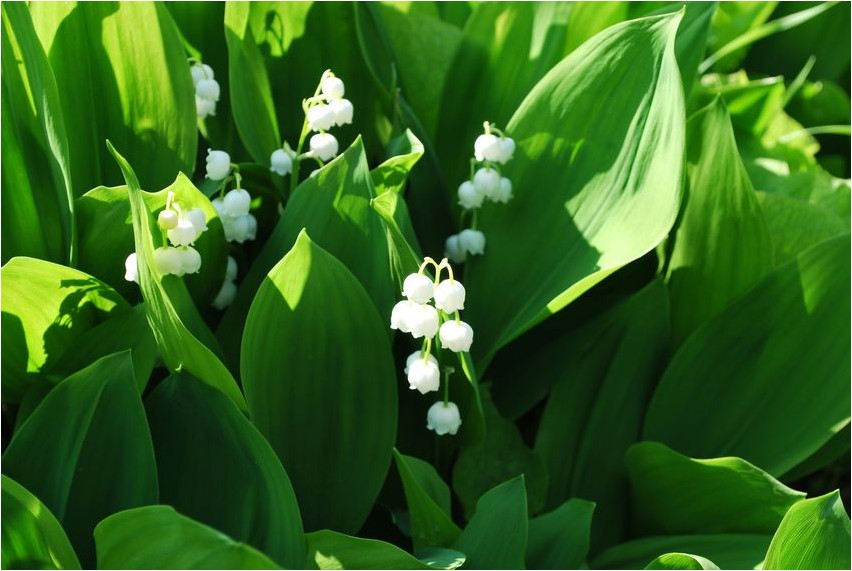
Lily of the valley (lat. Convallaria) is a flower crop, a perennial plant of the Asparagus family. There is only one species – May Lily of the Valley (lat. Convallaria majalis), which is divided into three subspecies.
In nature, lily of the valley is found in deciduous, pine and mixed forests, on forest edges and clearings in Europe, the Caucasus, Asia Minor, China and North America. In Russia, lilies of the valley are more common in the Far East, Siberia and the entire European part.
Characteristics of culture
Lily of the valley is a herbaceous plant with a creeping underground rhizome bearing several lower leaves, half-opened in the ground. The roots of the plant are very small, fibrous, and numerous. The basal leaves are entire, pointed, quite large, oblong-elliptical or broadly lanceolate in shape. Between the basal leaves there is a large bud.
The flowering stem protrudes from the corner of the lower leaves and bears a raceme consisting of 6-20 flowers facing one direction. The inflorescence is drooping and has a pleasant, pronounced aroma. The flowers are small, bell-shaped, most often white. The fruit is a spherical berry, orange in color, reaches 6-8 mm in diameter, contains 1-2 seeds. Lilies of the valley bloom from May to June, and bear fruit in June – July.
Growing conditions

Lily of the valley prefers fully shaded or semi-shaded areas, protected from northern piercing winds. The culture has a negative attitude towards lowlands with stagnant cold air, just as it does towards direct sunlight. Lilies of the valley are demanding regarding soil conditions; they grow well only in deeply cultivated, fertile, mineral-rich, moderately moist and drained soils with a neutral pH level.
Reproduction and planting
Lilies of the valley are propagated by seeds and cuttings of rhizomes. The seed method is used extremely rarely. Sowing is carried out either in early spring or autumn under cover in the form of a thick layer of peat or sawdust. Plants are propagated by cuttings of rhizomes in August, although to a greater extent the timing depends on the climate zone; as soon as the leaves begin to turn yellow, division begins. The planting sprout should consist of a section of rhizome with roots and one or two apical buds. The segments are planted in soil that has been thoroughly dug and fertilized in advance.
Care
Even a novice gardener can care for lilies of the valley. It consists of standard procedures for all flower crops, or more precisely, watering, weeding, fertilizing and loosening. Organic matter is added in the first year after young plants take root, and fertilizing with mineral fertilizers is carried out only the next year.
Watering is carried out moderately and regularly; the soil in a flower bed with lilies of the valley should always be moist, but not soggy, this is important. Overwatering has an extremely negative effect on the root system of plants. Lilies of the valley are frost-resistant plants and do not require shelter for the winter. The crop can grow in one place for up to 10 years, after which the plants are replanted.
It should be remembered that lilies of the valley are aggressive plant invaders. They produce a root growth of 15 to 25 cm per year. With proper care and favorable growing conditions, lilies of the valley form a fairly large flowering meadow, and the plants continue to occupy new territory. To prevent this from happening, lily of the valley thickets are thinned out once every 2-3 years. In addition, this procedure promotes abundant flowering.
Application
Lilies of the valley are early flowering plants that are highly decorative. They are used in various types of flower beds in combination with other spring crops. At first glance, lilies of the valley seem so fragile and delicate, but in fact the plant is hardy and remains viable for a long time in water. That is why living spaces are often decorated with lilies of the valley. The only disadvantage of this plant is that the strong aroma of the flowers usually causes headaches; to avoid this, the premises are regularly ventilated.
Lily of the valley is also known as a forcing plant. To force the rhizomes of the crop, they are dug out of the ground in the fall and stored in boxes with sand or peat in a cool room until December, after which they are planted in pots filled with a light nutrient substrate. Containers with plantings are transferred to a room with an air temperature of 20-24C and watered abundantly. After about a month, sprouts appear, and in February the plants bloom. Lilies of the valley are often used in folk medicine. It turns out that a tincture of leaves, stems and flowers of plants helps strengthen the cardiovascular system.
Lily of the valley, white lily of the valley
https://www. youtube. com/watch? v=0B0xp2bfYUg





