Angelonia
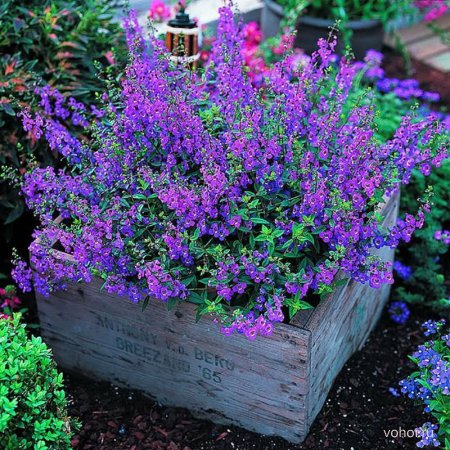
Angeaonia is a beautifully flowering annual plant. The method has about 30 varieties.
It reaches a height of 25-60 cm. It is distinguished by decorative and long flowering throughout its age. The flowers combine an unusual pattern and different colors. The flowers come in purple, light, light, and blue colors. Angelonia civilizes a luxurious bush that does not lack in additional education. It is permissible to grow indoors.
Care and cultivation of angelonia
The plant is unpretentious and does not require special care. Angelonia chooses sunny areas, but can also grow in light shade. The plant is resistant to drought, therefore, angelonia is rarely watered, exclusively during particularly dry and hot periods. When the flowers subsequently wilt and the peduncle responds, a new peduncle will soon appear and flowering will continue.
Some gardeners protect the plant by replanting it in a pot for the winter. In this case, angelonia is fed at room temperature; care comes down to watering.

reproduction

angelonia is planted with grains. Sowing of grains is carried out in advance, approximately in February. The grains are thrown into containers with a light and well-drained substrate. Before sowing, the substrate is disinfected using any calm method. The grains are not buried, because for the sake of germination they are in a hurry to shine. The grains germinate at a temperature of about 22-25 degrees, around film or glass. After the emergence of seedlings, the temperature of the contents is reduced to 18-20 degrees. Seedlings are watered modestly, not allowing the substrate to become waterlogged or dry out. Before planting in open soil, seedlings are often fed with mineral fertilizers containing nitrogen. Fertilizer intake should be low. Seedlings are planted in bare soil after they have avoided frost damage, usually in late May or early June. Presence of planting is ensured by a distance between plants of about 30-35 cm.
Propagation by cuttings is possible. For this purpose, in the fall the mother bush is transplanted into a pot and fed at room temperature, and in the spring cuttings are cut and planted in a soft substrate in a mini greenhouse.

diseases and pests
It can be affected by powdery sediment, but is completely resistant to diseases and pests.