Kepel
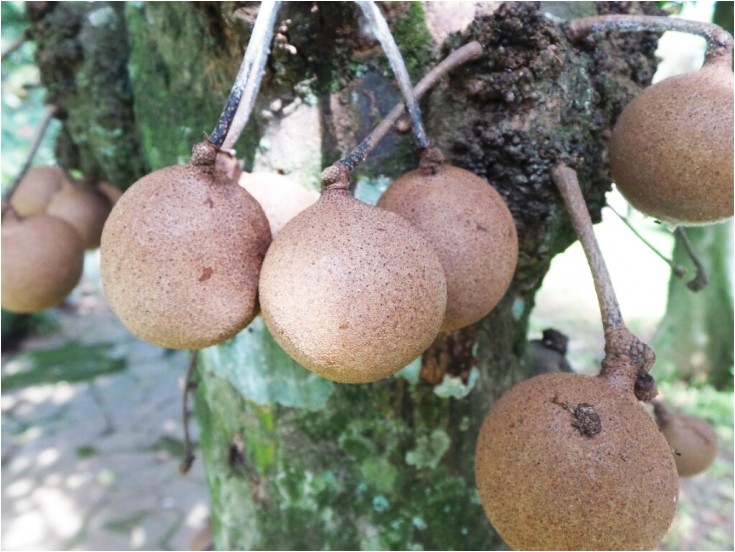
Kepel (lat. Stelechocarpus burakol) is a fruit crop belonging to the rather rich Annonaceae family.
Description
Kepel is an evergreen fruit tree whose height can reach up to twenty-five meters. And the thickness of its powerful branches often reaches forty centimeters.
Kepel fruits are oval or spherical berries that grow up to six centimeters in length and up to four and a half centimeters in width. By the way, the shape of these berries bears some resemblance to pears. Fruits grow not only on branches — quite often they can be seen on the lower parts of trunks, and the length of their stalks often reaches eight centimeters. As a rule, berries grow in clusters, and each cluster can contain up to sixteen fruits.
Each berry is covered on top with a brown, rough and rather leathery peel — its thickness can reach one millimeter. The juicy and sweet pulp of ripe berries has a brownish or orange color, while its taste is somewhat reminiscent of mango, and its aroma is similar to the aroma of violets.
Inside each fruit there are brown, flattened, oval-shaped seeds, the width of which does not exceed one and a half centimeters and the length of three centimeters. Typically, one berry contains from four to six seeds, although in some specimens they may be completely absent.
Where does it grow
Kepel is a plant native to Java. There it can be found up to a height of six hundred meters above sea level. By the way, in its homeland it is still considered the noblest culture, the fruits of which only aristocrats have the right to eat.

Individual trees are also found in a number of countries in Central America or Southeast Asia, as well as in the state of Queensland (Northern Australia) and in the state of Florida, but there they grow either as wild forms or as cultivated plantings.
Application
It is customary to eat only ripe berries — they differ from unripe specimens in that the films located under the rough peels change their color from light greenish to a calm pale brown or yellow.
The diuretic effect of the fruits allows them to be used to treat various kidney ailments. They will also serve well against gout, since the berries contain substances that help remove uric acid salts from the body. And the systematic use of young leaves of the plant helps reduce bad cholesterol.
Kepel juice is an excellent deodorant — when applied to the skin, it begins to exude a delicate violet aroma. And regular consumption of berries internally leads to the smell of violets being acquired by human sweat.
It should also be mentioned that kepel fruits have been used by the fair sex for contraception since ancient times, as they are endowed with the ability to cause temporary infertility.
Contraindications
There are no special contraindications to the use of kepel berries, however, individual intolerance and allergic manifestations cannot be ruled out at all.
Growing and care
Since kepel is very thermophilic, it can grow exclusively in tropical climates. It is very demanding when it comes to soil, but it grows extremely slowly. Kepel usually blooms in autumn (usually September-October), and fruit formation occurs in spring (March or April).
Kepel is a monoecious plant, which causes quite significant differences between female and male flowers. Male flowers are always smaller in size (up to one centimeter) than female ones, and they grow mainly in the upper part of the tree. As for the development of female flowers, it always occurs in the lower parts of the trunks, and their diameter often reaches three centimeters.
Mature trees can boast excellent yields — up to fifty kilograms per year (that”s about a thousand berries).





