Jacob’s godson
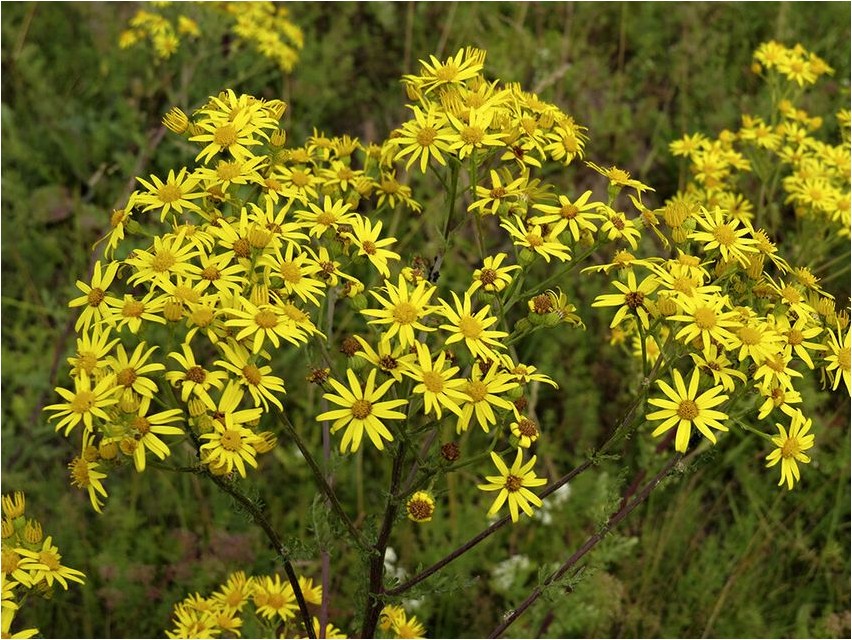
Jacob’s groundsel is one of the plants of the family called Asteraceae or Asteraceae; in Latin the name of this plant will be as follows: Senecio jacobaea L.
As for the name of the Jacob’s ragus family itself, in Latin it will be: Asteraceae Dumort.
Description of Jacob’s godson
Jacob’s ragwort is a perennial herbaceous plant whose height will vary between twenty and one hundred centimeters. Such a plant will be almost naked or cobwebby-pubescent; it will be endowed with a straight ribbed stem, which is branched at the top. The lower leaves are oblong-obovate and lyre-shaped in shape, the middle and upper leaves of this plant will be pinnately dissected. The baskets of the ragwort yalova will be numerous and they are in a corymbose inflorescence. The width of the involucre of this plant is about eight to ten millimeters. False-ligulate flowers are yellow in color and their length is about eight to ten millimeters. The marginal achenes of Jacob’s ragus are glabrous and endowed with tufts, while the inner achenes will be pubescent.
Jacob’s ragwort blooms in summer and autumn. Under natural conditions, this plant is found in the territory of Belarus, the Caucasus, Central Asia, Ukraine, the Siberian Arctic, Western Siberia, the Angara-Sayan region of Eastern Siberia, as well as in the European part of Russia with the exception of the Dvina-Pechora and Karelo-Murmansk regions. For growth, the plant prefers edges, meadow steppes, places among bushes, sparse forests, meadows, places on limestone, in crops and along roads. It is noteworthy that Jacob’s ragwort is a weed.
Description of the medicinal properties of Jacob’s godson
Jacob’s ragwort is endowed with very valuable healing properties, and it is recommended to use the herb of this plant for medicinal purposes. The term grass includes flowers, stems and leaves. The presence of such valuable healing properties should be explained by the content of saponins, essential oil, coumarins, rubber, alkaloids, flavonoids, terpenoids, polyacetylene compounds and sesquiterpenoids in this plant. The flowers of the godson yalova contain nectar, cosmen and the following alkaloids: jacoline, senecioin, senecifylline, jacobin, jacocin and yaconine.
It is noteworthy that the fresh herb of this plant is used in homeopathy in the form of an essence. As for traditional medicine, tincture and liquid extract of Jacob’s godson have become quite widespread. Such healing agents should be used for dysentery, amenorrhea and gonorrhea. Externally, such medicinal products are used as a wound healing agent, as well as for rinsing the mouth for throat diseases.

Fresh juice and alcoholic extract of the ragwort are recommended for use for diarrhea, cystitis, dysmenorrhea, tachycardia, painful and difficult urination, as well as for headaches due to anemia. External use of such products based on this plant is recommended as a wound-healing and emollient.
Infusion and decoction prepared from the herb of this plant should be used as a fairly effective hemostatic agent for metrorrhagia.
For gonorrhea, dysentery and amenorrhea, it is recommended to pour one part of the dry crushed herb of this plant with five parts of seventy percent alcohol. The resulting mixture should be infused for about seven to twelve days in a very well sealed container, after which the resulting mixture is filtered very carefully. Take this effective remedy based on Jacob’s ragwort two to three times a day, one teaspoon.





