Golden volodushka
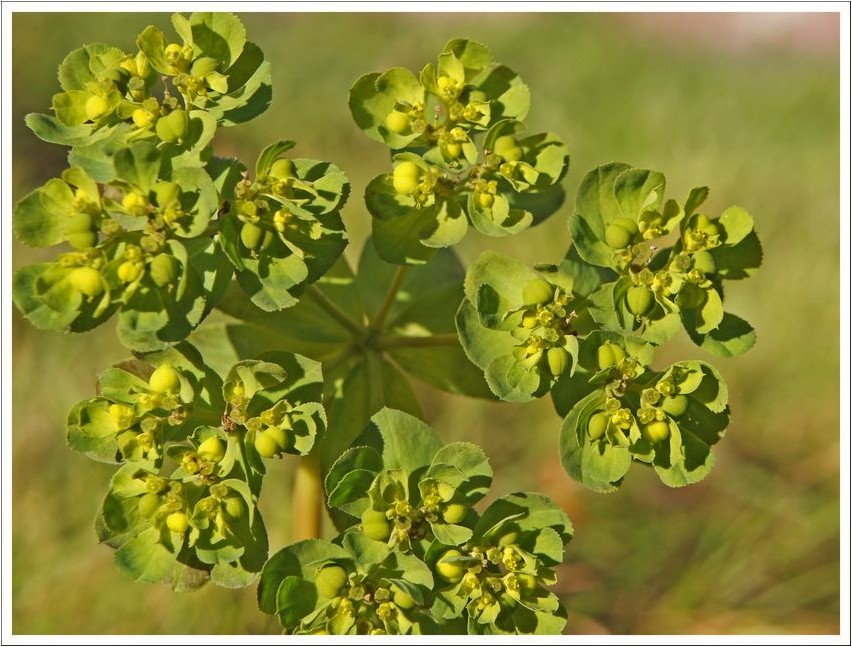
The aureus is one of the plants of the family called Umbellaceae; in Latin the name of this plant will be as follows: Bupleurum aureum Fisch.
As for the name of the golden beetle family itself, in Latin it will be: Apiaceae Lindl.
Description of golden gooseberry
Golden grass is a perennial herbaceous plant, the height of which can vary between twenty-five centimeters and one and a half meters. The stem of this plant is simple and smooth, usually solitary or slightly branched in its upper part. As for the stem leaves, they will be alternate, stem-embracing and sessile. Moreover, the upper leaves are almost pierced by the stem and are heart-shaped-ovate in shape, but the lower leaves have several sharply protruding veins, and they are oblong-ovate in shape.
In color, the flowers of the golden gooseberry will be yellow-greenish; they are collected in an umbrella, which consists of approximately ten to twelve rays. The fruits are two-seeded, oblong-elliptical in shape and dark brown in color. The flowering of this plant begins approximately in mid-summer and continues until autumn, and the ripening of golden capillary seeds occurs in the period from September to October. This plant has spread throughout the northeast and east of the European part of Russia, as well as throughout Siberia, the Urals and Central Asia. The plant prefers to grow in clearings, forest edges, light forests, river valleys, ravines, forests and mountain meadows.
Description of the medicinal properties of aureus
For medicinal purposes, it is recommended to use the leaves, roots and herb of goldenrod. The roots should be harvested in the autumn or early spring, but the leaves and grass of this plant should be harvested around June-August.
It is noteworthy that the chemical composition of this plant has not yet been sufficiently studied. This plant contains ascorbic acid, caratine, tannins, phytosterol, saponins, alkaloids and the following flavonoids in its flowers: rutinoside, rutin, quercetin and isoquercetin. It should be noted that this plant has antiseptic, choleretic, antipyretic, wound-healing and tonic properties. Actually, the action of the golden cucumber is very similar to the action of the sandy immortelle.

It has been proven that this plant has the ability to enhance the activity of the liver and pancreas. The plant can increase the amount of bile secreted, change its chemical composition, and also increase the amount of acids, cholesterol and pigments.
An infusion prepared from the herb aureus is particularly effective in the treatment of hepatitis and cholecystitis. It is worth noting that the leaves and flowers of the aureus have a more active effect.
As for traditional medicine, a decoction of the roots of this plant is used for malaria, while fresh and even dry leaves are useful for healing wounds. Moreover, in Chinese folk medicine this plant is used to heal the gallbladder and liver, as well as for headaches, dizziness and various infectious diseases. As for the external use of aureus, it is used to relieve itching of the skin and for washing pustular diseases.
It is important to remember that the use of this plant is contraindicated for peptic ulcers, cholelithiasis, gastritis and duodenal ulcers.





