Sea buckthorn
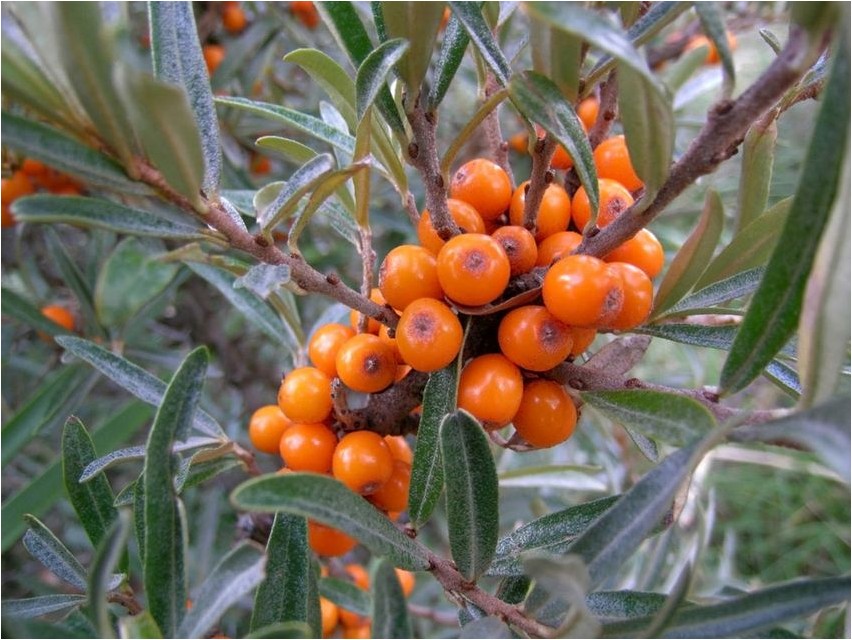
Sea buckthorn is one of the plants of the family called Suckeraceae; in Latin the name of this plant will be as follows: Hyppophae rhamnoides L.
As for the name of the buckthorn family itself, in Latin it will be: Elaengaceae Juss.
Description of sea buckthorn
Sea buckthorn is a dioecious and strongly thorny shrub that is branched. In addition, this plant can also be a tree, the height of which will fluctuate between one and a half and six meters. Such a plant is endowed with a well-developed superficial root system, as well as abundant root suckers and root nodules with nitrogen-fixing bacteria. Young shoots of this plant are silvery with covering scales and star-shaped hairs. Later, such shoots turn brown or dark brown. The leaves of sea buckthorn will be simple, alternate, short-petiolate and linear, their length will be two to eight centimeters. On top, such leaves will be colored gray-green, and below they can be either brownish-silver-white or slightly yellowish. The flowers of this plant are rather small and inconspicuous; they will be endowed with a simple perianth, which consists of two leaflets. Such flowers will be colored yellow. Pistillate flowers will sit in the very axils of twigs and spines, while staminate flowers are collected in short spikes. The fruits of sea buckthorn are juicy and shiny drupes that can be colored orange, red or golden yellow. Such fruits will stick quite thickly to the ends of the branches.
Sea buckthorn blooms from April to May, while the fruits of this plant ripen in September-October. It should be noted that sometimes the fruits of this plant can remain on the branches until spring. Under natural conditions, sea buckthorn is found in Ukraine, the Caucasus, Moldova, Central Asia, the southeastern regions of the European part of Russia, as well as in Eastern and Western Siberia.
Description of the medicinal properties of sea buckthorn
Sea buckthorn is endowed with very valuable healing properties, and it is recommended to use the bark, fruits, seeds and leaves of this plant for medicinal purposes. However, the most widespread is sea buckthorn oil, which is obtained from the pulp of fruits and seeds. Leaves should be harvested from May to early June.
The presence of such valuable healing properties should be explained by the content of ascorbinase in the fruits of this plant, which will ensure excellent preservation of ascorbic acid. The seeds of this plant contain pectin, carbohydrates, triterpenoids, carotenoids, organic acids, steroids, higher fatty acids and phenolcarboxylic acids. The bark of the branches of this plant will contain tannins, serotin, and the leaves also contain tannins and vitamin C.

The fruits and sea buckthorn oil are endowed with a very effective wound-healing, bactericidal, anti-inflammatory, analgesic, epithelizing agent, as well as the ability to increase the body’s resistance to ionizing radiation.
Sea buckthorn oil is endowed with regenerative properties, will stimulate the growth of granulation in case of various damage to the skin and mucous membranes, and also has the ability to provide antibacterial effects. In addition, such oil will activate the exocrine activity of the pancreas.





