Chickweed average
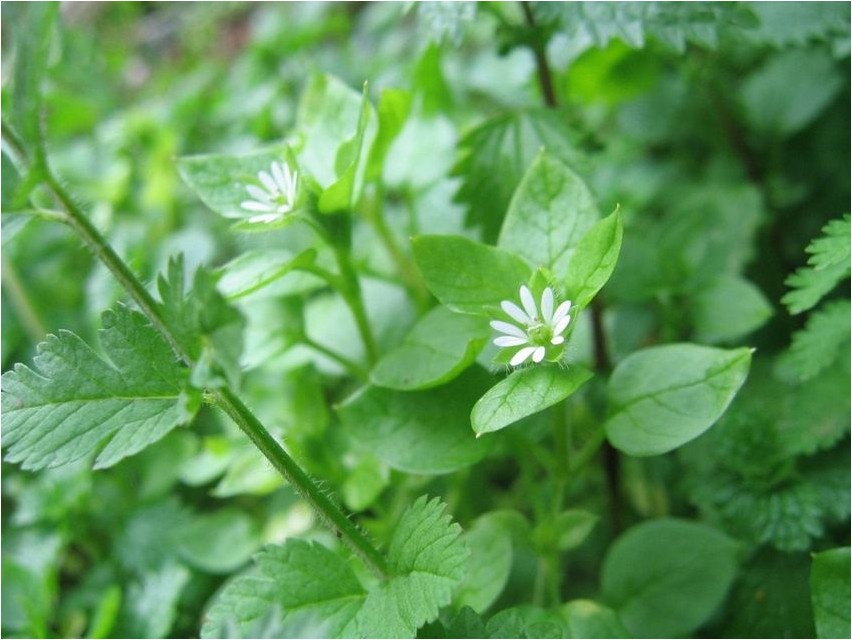
Chickweed is one of the plants of the family called Cloveaceae; in Latin the name of this plant will be as follows: Stellaria media L.
As for the name of the chickweed family itself, in Latin it will be: Caryophyllaceae Juss.
Description of chickweed
Chickweed is also known as chickweed. Chickweed is an annual herbaceous plant whose height is about ten to thirty centimeters. The stems of this plant will be thin, branched, tetrahedral, erect, usually such stems are endowed with fairly well-developed shortened axillary shoots. The leaves of this plant can be either linear or lanceolate or linear-lanceolate, their length reaches four centimeters, and the width will be equal to five millimeters; at the base along the edge the leaves will be ciliated. It is noteworthy that the flowers of this plant are very small, they are painted in white tones, and are also endowed with bipartite petals, which are located on one-sided pubescent pedicels. The inflorescence of this plant is spreading, it is multi-flowered, the bracts are membranous, and at the edges they are endowed with cilia. The sepals of the average chickweed are lanceolate and glabrous, they are endowed with three glandular cilia. The fruits of this plant are oblong boxes that will be significantly longer than the calyx itself.
The average chickweed blooms from May to August. Under natural conditions, this plant is found in the European part of Russia, the Far East, Western and Eastern Siberia, as well as in Central Asia, Belarus and Ukraine. For growth, the plant prefers garbage places, vegetable gardens, places near housing, damp forest edges, river banks and ravines. It should be noted that the plant is a malicious weed of garden crops.
Description of the medicinal properties of chickweed
Chickweed is endowed with quite valuable healing properties, and it is recommended to use a fresh plant and its juice for medicinal purposes. The presence of such valuable healing properties is explained by the content of triterpene alkaloids and saponins in the plant.
This herb is widely used in both homeopathy and folk medicine. It is used as a pain reliever, diuretic, expectorant, and hemostatic. It is also used for constipation, appendicitis, enterocolitis, and various gastrointestinal ailments.

Both an infusion of fresh herb and its juice are used for various internal inflammatory conditions, including bronchitis, pneumonia, colds, coughs, scurvy, beriberi, postpartum illnesses, hepatitis, heart pain, and various liver diseases.
An infusion of this herb is also recommended for children with convulsions or as a bath to strengthen the nerves. It is also used as a pain reliever for gout and rheumatism. An infusion of chickweed and its juice are also used for tumors of various locations. For external use, fresh herb in the form of compresses should be applied to boils, benign tumors, cancerous tumors, hemorrhoids, and abscesses. A fairly strong infusion in the form of poultices and wet compresses should be used for cuts, poorly healing wounds, ulcers, and various skin conditions, such as acne and rashes. It’s worth noting that the plant has the ability to stain fabrics blue.





