Campanula glomerata
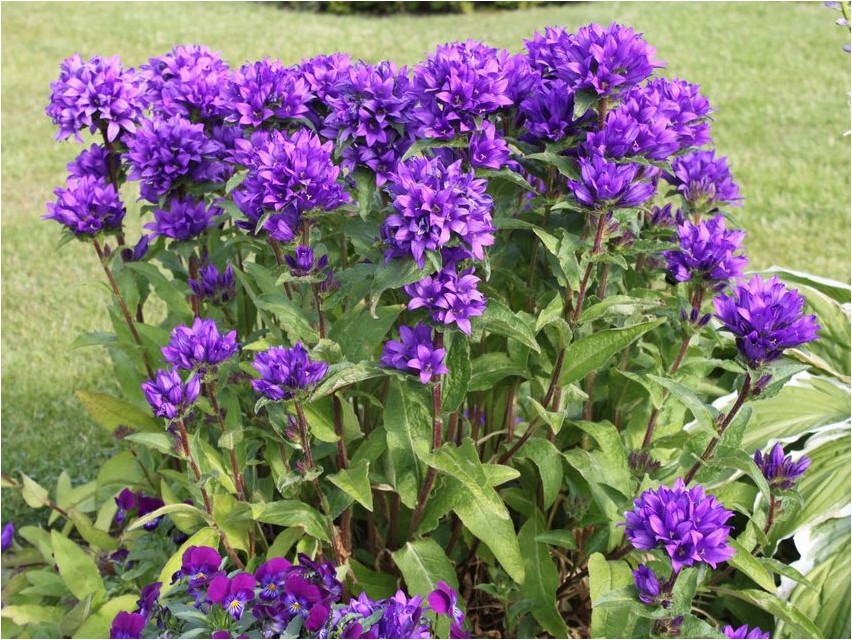
Campanula glomerata is a member of the Campanulaceae family. Its Latin name is Campanula glomerata L.
The family name of Campanula glomerata is Campanulaceae Juss.
Description of Campanula glomerata
Campanula glomerata is a perennial herbaceous plant, reaching heights between twenty and sixty centimeters. The stem is usually simple and can often be reddish in color. The stem can also be hairy and slightly serrated. The leaves of Campanula glomerata are ovate or ovate-lanceolate, with the lower leaves on long petioles and the upper leaves sessile. The flowers of this plant are quite small, bell-shaped, and arranged in a discontinuous inflorescence, with yellow-purple hues. The flowers cluster into a dense apical head and fairly dense axillary buds. Up to one-third of the corolla of the Campanula clumpata will be divided into lobes. The fruit of this plant is a capsule that opens with openings at the top.
The Campanula clumpata blooms in the summer, from June to August. In the wild, this plant is found throughout the European part of Russia, Belarus, Central Asia, Ukraine, and Siberia to Transbaikalia. It prefers forest clearings, clearings, forest edges, steppes, shrubby areas, mountain slopes, and meadows. It should be noted that the plant does not form dense thickets, but is most often found scattered. Description of the medicinal properties of Campanula clumpata
Campanula clumpata possesses highly valuable medicinal properties, and its herb is recommended for medicinal purposes. The herb includes the flowers, leaves, and stems. It is recommended to harvest this material from June to August.
The plant’s valuable medicinal properties are explained by its content of carotene, quercetin, kaempferol, caffeic acid, and coumaric acid. The leaves of Campanula clumpata also contain ascorbic acid.
The plant is endowed with hemostatic, anti-inflammatory, sedative and analgesic effects. As for traditional medicine, an infusion made from the herb of the bellflower is quite widespread. This infusion is recommended for rinsing for various inflammatory processes occurring in the oral cavity, for stomatitis and sore throat, and the infusion is also taken orally for erysipelas, headaches and heavy menstruation. For fever, atherosclerosis, aches, constipation, syphilis, glaucoma, gastralgia and atherosclerosis, it is recommended to use a decoction prepared from the herb and fruits of bellflower. Children with epilepsy are also bathed in this decoction.

It is recommended to sprinkle the powder of the herb of this plant on lichens and panaritiums; compresses and poultices from the herb of the bellflower should be applied to the dog bite sites.
For insomnia, it is recommended to use the following remedy based on this plant: to prepare such a remedy, take two teaspoons of bluebell herb mixed with one glass of boiling water. The resulting mixture should be infused for two hours, and then the mixture should be filtered very carefully. Take the resulting product one or two tablespoons before meals. It is noteworthy that this infusion can also be used for gargling.
Bluebell crowded
Campanula glomerata
Bluebell crowded bluebell





