Avran
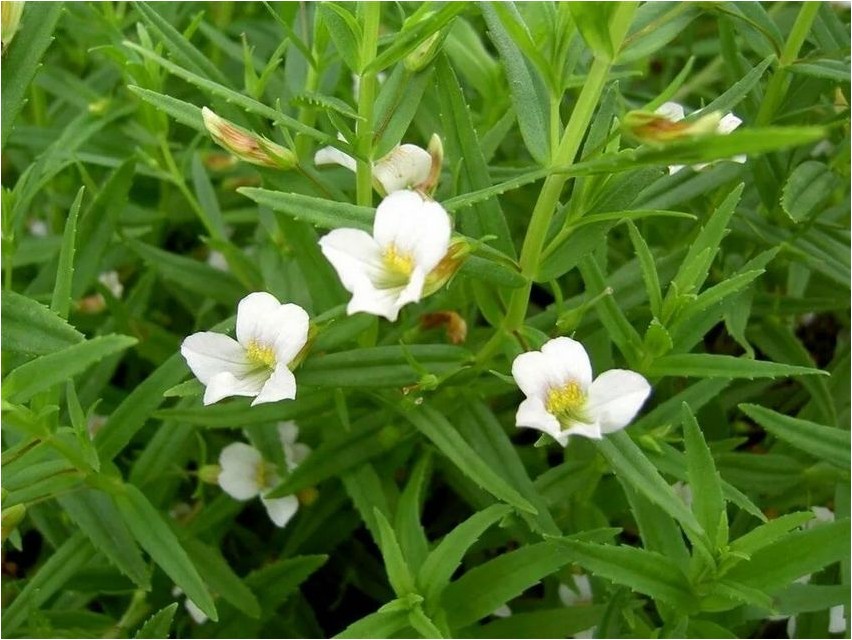
Avran is also sometimes known under the following names: grace grass, fever herb, bloodworm, moknets.
Description of Avran
Avran is a herbaceous plant that can reach a height of about sixty centimeters. It is important to note that the stem of the plant is almost straight and does not branch.
The leaves of this plant can reach even six centimeters in length. The leaves extend from the stem itself, and they will be located opposite each other. The leaves of Avran are endowed with lanceolate shapes, while at the very edge of the base they will be smooth, after which they become jagged, on which there are about three longitudinal veins.
The creeping rhizome of this plant is directed horizontally. The rhizome will have scaly leaves, and the rhizome itself will break into several parts. Single flowers of this plant are located on a long stalk. The flowers have five petals, which can be either white or pinkish in color. All these flowers are also equipped with a yellow tube. The avran fruit is an egg-shaped capsule; this capsule will contain a very impressive number of rather small seeds. These seeds are colored either brown or brown tones, and are also dressed in oblong shapes.
This plant blooms from the end of May to the month of September. Avran fruits appear as early as July. The plant prefers moist soil; for this reason, the auran can be found in natural conditions near rivers, swamps and lakes. This plant grows in the European part of Russia, Siberia and the Caucasus.

Medicinal properties of avran
A species such as Avran officinalis has very significant healing properties. For this purpose, both rhizomes and grass should be used. In this case, the grass should be harvested in the autumn, but it is recommended to collect the grass during the flowering period of the plant.
Avran officinalis is capable of having antimicrobial, choleretic, emetic, laxative, and anti-inflammatory effects. The rhizomes of this plant should be used as a laxative, emetic or diuretic. In addition, rhizomes are also used for chronic constipation, as well as for helminthiasis. The herb Avran officinalis should be used for various diseases of the liver and spleen, as well as for varicose veins, eczema, dermatitis, rheumatism, heart failure, bruises and a number of hematomas. It is noteworthy that the infusion of Avran can also cause a sharp aversion to smoking.
This infusion of Avran officinalis can be prepared as follows: you will need to take two grams of the raw material and pour boiling water into glasses. After this, the resulting mixture should be infused until it cools completely. This infusion of Avran officinalis should be taken one tablespoon every two hours.
To obtain an anthelmintic effect, a decoction of Avran officinalis is recommended. To do this, you need to take half a teaspoon of raw material and pour a glass of hot water. This mixture should be boiled for thirty minutes in a water bath. Then this mixture should be strained while it is hot. The resulting decoction should be taken every twenty minutes, a teaspoon at a time until the desired effect occurs.
For injuries, you can use bandages with freshly crushed grass. It should be remembered that there are certain contraindications to the use of Avran officinalis. This should include those diseases that cause vomiting, as well as pregnancy and cholelithiasis.





