Pharmaceutical burdock
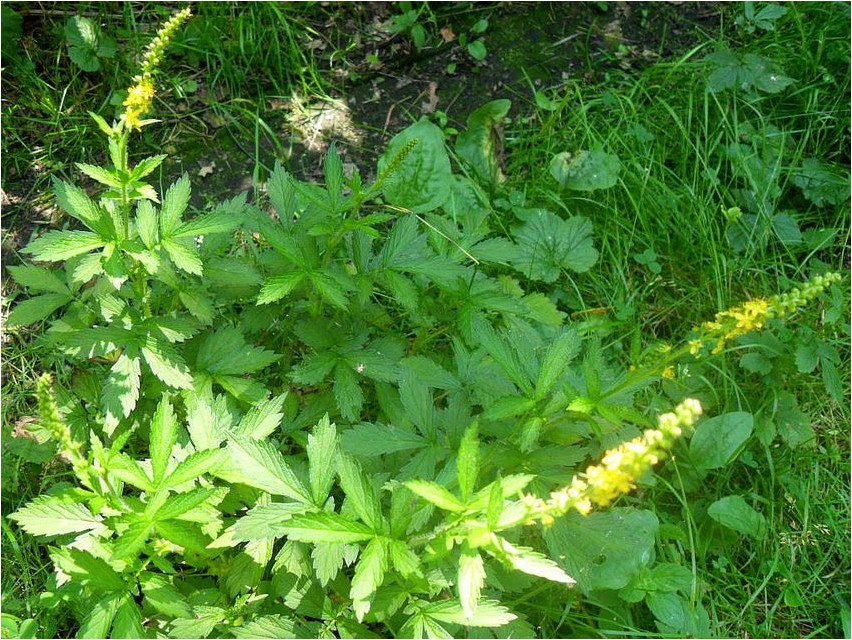
The agrimony is one of the plants of the family called Rosaceae; in Latin the name of this plant will be as follows: Agrimonia officinalis L.
As for the name of the burdock family itself, in Latin it will be: Rosaceae Juss.
Description of burdock
The agrimony is a perennial herbaceous plant, the height of which will fluctuate between thirty and one hundred and twenty-five centimeters. The stem of this plant will be rough-petalled and erect, its height is about eighty to ninety centimeters. The leaves of thistle are intermittently pinnate. The flowers of this plant are arranged in a rather long spike-shaped inflorescence, and such flowers will be colored in golden-yellow tones. The calyx of the burdock will be five-parted and endowed with five petals.
This plant blooms from June to July. Under natural conditions, the agrimony is found in the Caucasus, Belarus, Ukraine and all regions of the European part of Russia, with the exception of the Lower Volga region. For growth, this plant prefers sparse forests, shrubs, meadows, places along the edges of roads and fields, edges from plains to mid-mountain zones.
Description of the medicinal properties of burdock
The burdock is endowed with very valuable healing properties, and it is recommended to use the roots and herbs of this plant for medicinal purposes. The term grass includes leaves, stems and flowers.
The presence of valuable healing properties should be explained by the content of catechins and tannins in the roots of this plant, while the herb will contain phenol carbonic acids and their derivatives, rhamnose, ribose, fructose, glucose, polysaccharides, arabinose, sucrose, vitamin C, coumarins, tannins, saponins, steroids, fatty acids, wax, higher aliphatic alcohols, choline, nicotinic acid, caffeic and ellagic acids. The fruits of this plant contain tannins; the seeds contain B vitamins, traces of nicotinic acid, fatty acids and potassium salts.

Burdock is endowed with very valuable anti-inflammatory, antibacterial, diuretic and anthelmintic properties.
As for traditional medicine, here this plant is quite widespread. Traditional medicine recommends using the herb for rheumatism, bitterness, diarrhea, and also as a diuretic, for hemorrhoids, ascites, bronchitis, helminthiasis, for various malignant tumors of internal organs, internal bleeding, for diseases of jaundice, liver and oral cavity, as well as for gastrointestinal diseases. The leaves of thistle are used for diarrhea, liver and lung diseases, and are also used as an anthelmintic; externally, such leaves are indicated for use in gingivitis and stomatitis. An infusion prepared from the flowers of this plant is used for various skin lesions and hemorrhoids. As for Chinese medicine, the green parts of the agrimony are used as a hemostatic agent.
For enuresis, you should take five tablespoons of the herb in two glasses of boiling water, after which this medicinal mixture should be left to infuse for fifteen minutes, then the resulting mixture should be filtered very carefully. Take the resulting healing remedy based on burdock three times a day, half a glass.





