Echinocystis
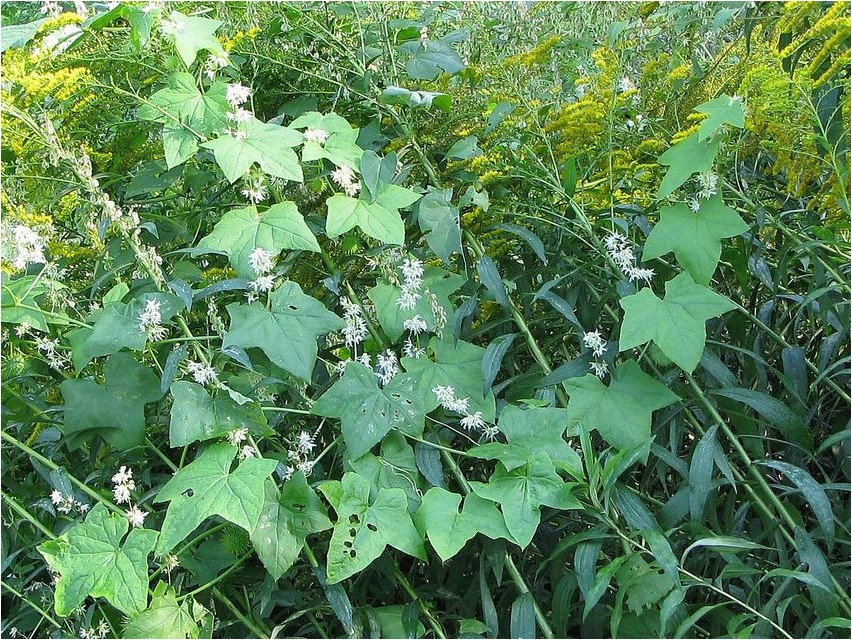
Echinocystis (lat. Echinocystis) is a genus of herbaceous plants of the Pumpkin family. Other names are thorny cucumber or mad cucumber. The genus includes 15 species, distributed in the Mediterranean, China, Japan, North America, Atlantic and Central Europe.
In Russia, only one species is found — Echinocystis lobata, or Echinocystis lobata. It is used as an ornamental crop; if growing and care conditions are not met, it often runs wild. Echinocystis is extremely aggressive, grows quickly and fills empty spaces. Typical places of growth are neglected gardens, holiday villages, coastal areas.
Characteristics of culture
Echinocystis is a herbaceous liana that, during its growth, forms a fibrous root system and abundant thickets of decorative leaves. The stems are thin, succulent, pubescent, branched at the nodes, clinging to the support with the help of 3-4 divided tendrils. The leaves are pale green, alternate, long-petiolate, glabrous, deeply notched at the base, 3-5-7-lobed, up to 15 cm long.
The flowers are dioecious, regular in shape, and have a subtle honey aroma. Staminate flowers sit singly on peduncles, collected in erect panicles. The corolla is white in color, with glandular-pubescent linear or lanceolate-curved lobes. Pistillate flowers are collected in bunches of two or single.
The fruit is a broad-ovoid, bluish-green pumpkin, covered with short spines over its entire surface. The seeds are flattened, elliptical or oblong-oval, light brown, brown or black. Echinocystis blooms in June-September, the fruits ripen in August-October, which completely depends on climatic conditions.
Subtleties of cultivation

Echinocystis is propagated by seeds. The crop is sown before winter using the nesting method. 2-3 seeds are placed in the nest. Planting depth is 1. 5-2 cm. In spring, seedlings are thinned out, leaving one plant per nest. The distance between plants in a row should be about 80-100 cm.
The plant prefers light, loose, moisture- and breathable soils with a neutral reaction. Echinocystis does not accept acidic, heavily waterlogged and heavy soils. The culture is not demanding in terms of location; it develops well both in the sun and in dense shade. Echinocystis is relatively cold-resistant, but responsive to heat.
It has a negative attitude towards heat, develops slowly and quickly turns yellow. The best predecessors are root vegetables, onions and potatoes. Care consists of feeding, which is carried out twice per season: the first — during flowering, the second — during fruiting. The use of nitrophoska and mushy mullein as fertilizers is not prohibited.
Application
Echinocystis is grown in gardens and household plots as a honey plant and ornamental plant. Suitable for vertical gardening of balconies, arches, fences, walls of houses and buildings. It is also cultivated to form green trellises. The plant is also used in folk medicine. The fruits contain a large amount of substances beneficial to the human body, such as mineral salts, pectin and enzymes.





