Plantain rough
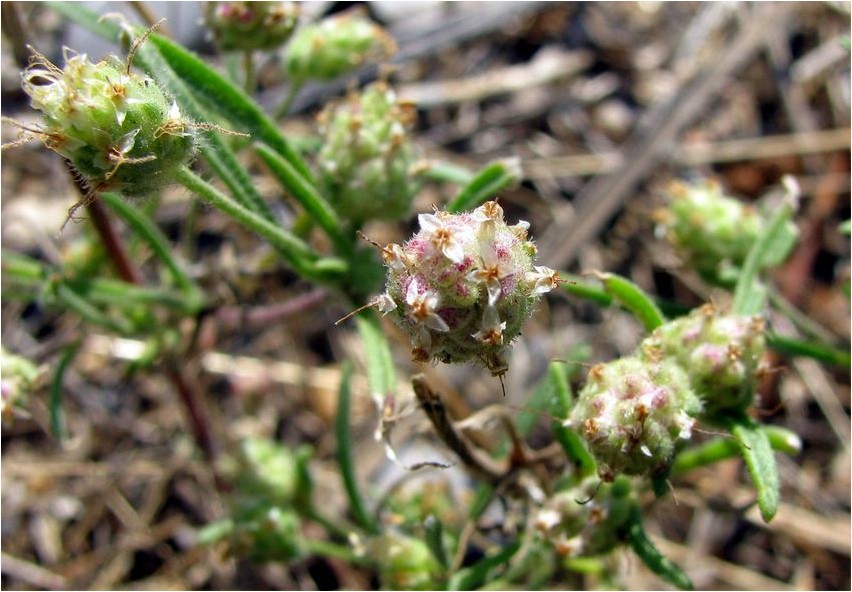
The rough plantain is one of the plants of the family called plantains; in Latin the name of this plant will be as follows: Plantago scabra Moench [P. avenaria Waldst. et Kit., P. indica L., P. ramosa (Gillb.) Aschers.].
As for the name of the rough plantain family itself, in Latin it will be: Plantaginaceae Juss.
Description of plantain
Rough plantain is an annual herbaceous plant whose height will vary between five and sixty centimeters. The stems of such a plant will most often be erect, and also more or less branched. The stems of rough plantain are endowed with opposite and rather long branches. The leaves of this plant are oblong-ovate, their width is about one to three millimeters. The spikes of rough plantain will be compact and dense, and in outline they are oblong-ovoid, their length is no more than one and a half centimeters. It is noteworthy that the two lower bracts of this plant will be different in shape from all the others; they will be wide at the base, and also more or less pubescent and rounded. The lobes of the plantain corolla are ovate-lanceolate and rather sharp. In outline, the box of this plant will be broadly elliptical, and at the top it will be rounded; the length of such a box is about three to three and a half millimeters, and in addition to this, the box is also double-lobed. The seeds of rough plantain will be shiny and oblong-elliptical, their length is equal to two and a half millimeters, such seeds will be colored brownish-black.
This plant blooms from June to August. Under natural conditions, rough plantain is found in Moldova, Ukraine, Belarus, Western Siberia, the Far East, Central Asia, as well as all regions of the European part of Russia, with the exception of only the Dvina-Pechora and Karelo-Murmansk regions. For growth, this plant prefers outcrops of chalk and limestone, pebbles and sand, as well as places near roads.
Description of the medicinal properties of rough plantain
Rough plantain is endowed with very valuable healing properties, and it is recommended to use the seeds and the entire above-ground part of this plant for medicinal purposes. The presence of such valuable healing properties should be explained by the content of alkaloids and other nitrogen-containing compounds in this plant, as well as the following iridoids: plantarenoside, aucuboside and aucubin. The aerial part of plantain will in turn contain alkaloids, plantarenoside and other nitrogen-containing compounds. The seeds of this plant contain steroids, alkaloids, carbohydrates and other related compounds.
It should be noted that the ethereal extract of the aerial part of plantain will be endowed with antibacterial activity against lactic acid bacteria.

As for traditional medicine, here healing remedies based on this plant have become quite widespread. A decoction prepared from plantain seeds is recommended for use for hemorrhoids, diarrhea, urethritis, gonorrhea, and various diseases of the kidneys and bladder. In addition, such a decoction based on the seeds of this plant is also used as a laxative for chronic constipation, and can also be used as an emollient and sedative. Poultices based on this plant are used for ulcers, tumors and conjunctivitis, while the mucus is used for dysentery, and the plant itself, when crushed, is used as a laxative.