Wolfberry
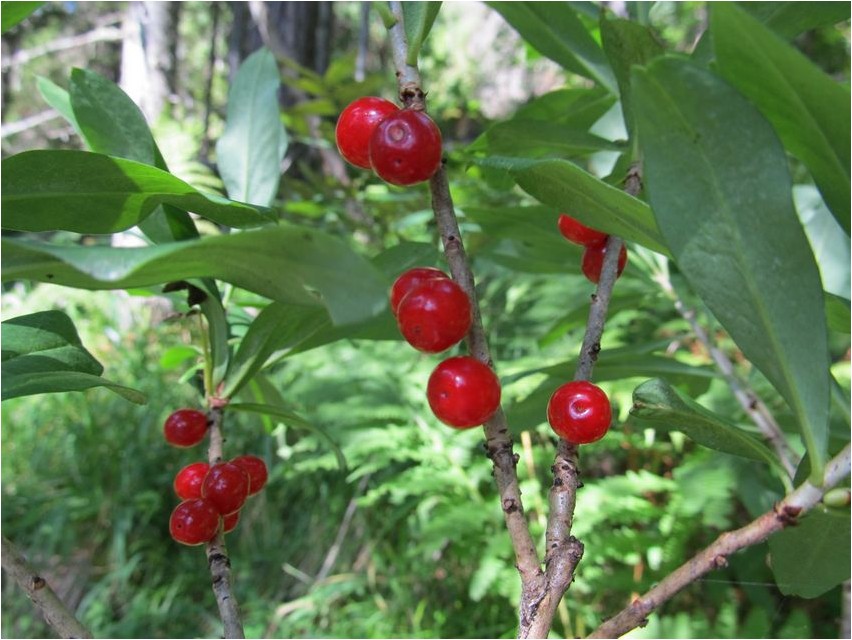
Wolfberry (lat. Daphne) is a genus belonging to the Wolfberry family. Other names are Daphne or Wolf”s Bast. In nature, plants are found in European and Asian countries.
Today, more than 40 species have been identified, a small part of which grow on the territory of the Russian Federation. The plant is known for its fragrant flowers and berries, which contain toxic substances.
Description
Wolfberry bushes are represented by deciduous or evergreen shrubs that reach a height of 150 cm. They have a wide spreading crown and bear a huge number of whole, short-petiolate, harsh, lanceolate or elliptical, alternate leaves. The flowers of wolfberries are fragrant, small, sessile, collected in racemes, fascicle-shaped or capitate inflorescences, formed on last year”s shoots. The flowers consist of four or five petals fused at the base and, depending on the variety, can be greenish, yellowish, whitish or pale pinkish in color. Wolfberry blooms for a long time, sometimes 1 month, and occurs in early spring. The fruit has a spherical shape, the color is black, deep red or bright yellow. =
Description
Wolfberry plants are shade-tolerant crops and thrive best in the shade. In addition, air humidity is important for plant development; it should be at least 85%. The wolfberry has a negative attitude towards the open sun. For growing plants, fertile, moist, permeable, drained, loose soils, from acidified to alkaline, are desirable. Humus-rich loams are suitable for wolfberry gardens.
Features of reproduction
The crop in question is propagated by seed and vegetatively (by cuttings, root suckers and dividing the bush). Wolfberry seeds are not stored for a long time, so they should be sown. in the fall after collection. Seeds are planted to a depth of two centimeters. The distance between plants should be about 25-30 cm. The first seedlings hatch in early spring of next year; in August or early September, young plants are planted in the area where permanent cultivation is planned.

Cuttings of the crop in question are carried out in June. The cuttings are dipped in a solution of growth stimulants for several hours, then planted in a moistened substrate for rooting. It is better to plant them in greenhouses or put polyethylene on top, which will not stick to the cuttings. Cuttings with roots are planted in the new area where cultivation is planned in September. The soil for plants is prepared in advance: it is treated with a shovel and rake, and mineral and organic fertilizers are applied.
Care procedures
Wolfberry plants are moisture-loving plants that require frequent but moderate watering. If it is not possible to provide an optimal level of moisture, mulch can help retain it. Deep loosening, as well as digging up the soil of plants, is not necessary; the roots are located too close to the surface and can be damaged.
In late autumn, preventive pruning is carried out, which involves the removal of old, thickening, broken and damaged branches. The wolfberry does not accept drastic pruning. Formative pruning involves giving the bushes a symmetrical crown shape.
Organic and mineral fertilizers are applied in April, as well as in the fall, but before the onset of frost. Plant transplantation is poorly tolerated, so this operation is not worth carrying out.
Usage
Wolfberry plants are widely used in ornamental gardening. They are suitable for both single and mixed plantings. Dwarf varieties are ideal for decorating rock gardens and rockeries. Wolfberry is suitable as a background for perennial flower crops, including bulbous ones. You can plant crops along the paths.