Cassava
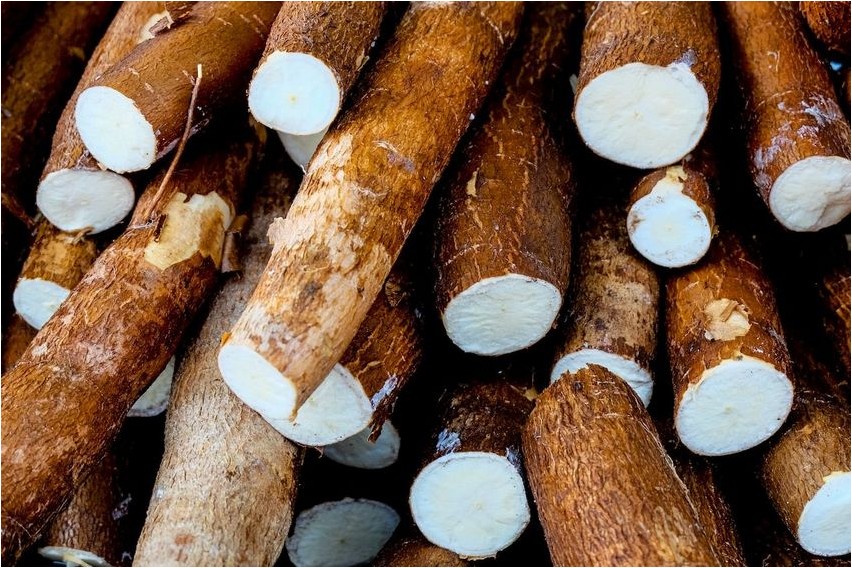
Cassava (lat. Manihot) is a genus of shrubby plants of the Euphorbiaceae family. The genus has more than 100 species, of which the most common is the edible cassava (lat. Manihot esculenta).
The plant is cultivated in countries with subtropical and tropical climates as a food crop. Other names are maniot or cassava.
Characteristics of culture
Cassava is a perennial, fast-growing plant up to 4 m high. The leaves are palmately dissected, green, thyroid-shaped, arranged alternately. The flowers are small, dioecious, collected in long paniculate inflorescences. The fruit is a capsule. The rhizomes are tuberous, swollen, up to 1 m long, average weight is 10-12 kg.
Subtleties of cultivation
Cassava is a heat-loving crop; it prefers well-lit areas, protected from strong gusty winds. Has a negative attitude towards prolonged drought. The optimal growing temperature throughout the growing season is 25-30C. The soils for cassava are loose, drained, fertile, neutral, with a high humus content. The culture does not accept saline, waterlogged, acidic and waterlogged soils. The shadow also negatively affects the development of culture.
Cassava is propagated vegetatively and by seeds. The seed method is applicable only for breeding purposes. Cuttings are the most common method. Cuttings are taken from the middle or lower part of the stem of plants 9-12 months old. The optimal cutting length is 10-40 cm. It is recommended to plant cuttings between the end of the dry and the beginning of the rainy seasons. Moisture availability of planting material is one of the main conditions for successful cultivation. The area for the crop is prepared 20-30 days before the intended planting: the soil is dug to a depth of 15-20 cm and mineral fertilizers are applied. Deep tillage is undesirable, since the plants in this case form too long root tubers, which are very difficult to remove.
Cassava is planted using a wide-row method. Overseeding of other crops such as yams, beans, watermelon, etc. is not prohibited. Cassava can be planted in furrows or ridges. Cuttings are planted in a longitudinal position. The distance between grooves is 80-120 cm, between cuttings — 60-70 cm. Vertical planting is also possible. For this method, high ridges are prepared. The distance between cuttings in this case is 80-160 cm. Early ripening varieties of cassava can be planted more densely.

Care consists of hilling, weeding, watering, and fertilizing. Since cassava draws all the minerals from the soil, fertilizing is vital. The crop especially requires nitrogen, potassium, and phosphorus fertilizers; micronutrients are not harmful. The growing season of early-ripening cassava varieties ranges from 6 to 8 months, while late-ripening varieties last from 12 to 16 months. For this reason, growing the crop in Russia is difficult.
Harvesting and Storage
Harvesting begins when the seeds have fully ripened and the leaves have fallen. Unripe tubers have little flavor and do not cook well. Harvesting is done by hand. The cassava stem is cut at a height of 40-50 cm, after which the rhizomes are pulled out. The rhizomes do not store well, especially in subtropical and tropical climates. They typically become unusable within 2-3 days after harvesting. That”s why, on the day of harvest, they are washed, peeled, chopped, dried in the open sun for 3-5 days, and ground to a powder.





