Mirabilis multiflorum
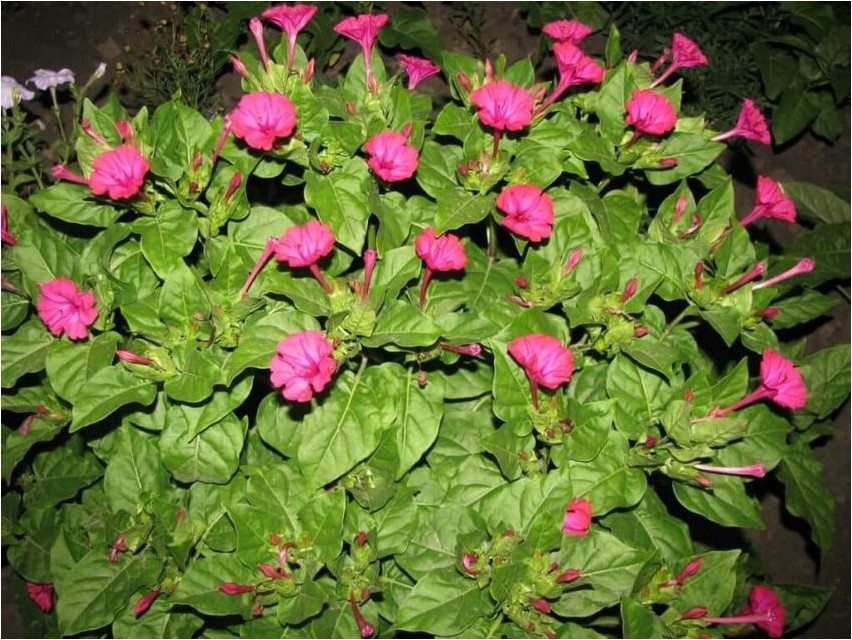
Mirabilis multiflora (lat. Mirabilis multiflora) is a perennial flowering herbaceous plant of the genus Mirabilis (lat. Mirabilis), which is a representative of the family Nyctaginaceae (lat.
Nyctaginaceae). Mirabilis multiflorum broke the tradition of plants of the genus to open flower petals at night, choosing the sunniest time of day for such a solemn moment. Its large funnel-shaped flowers are collected several times in one cup, creating the illusion of a bouquet standing in a flower vase.
What’s in your name
If to understand the meaning of the generic name “Mirabilis” we have to resort to the help of a Latin-Russian dictionary, in which we find that this word is equivalent to the Russian “amazing”, “wonderful”, then the specific epithet of the plant “multiflora” is almost understandable even without a dictionary. But it’s still better to look into the Latin-Russian dictionary to make sure that the subconscious memory has not deceived you and this word in Russian means “many-flowered.” Looking at a flowering plant, you are even more confirmed in the correct understanding of the Latin species epithet.
Description
Since in the wild Mirabilis multiflora lives in dry regions of the southwestern United States, in places with poor sandy or rocky soils, the plant has long roots that penetrate deep into the soil, which support the powerful herbaceous above-ground parts with moisture and nutrients and ensure the longevity of the plant.
Erect numerous stems up to 80 centimeters high with short-petioled large (up to 12 centimeters long) brown-green leaves form dense picturesque thickets. The fleshy leaf plate with a light midrib has a round or oval-elongated shape with a sharp tip. The surface of the leaf blade is often bare, less often covered with hairs.
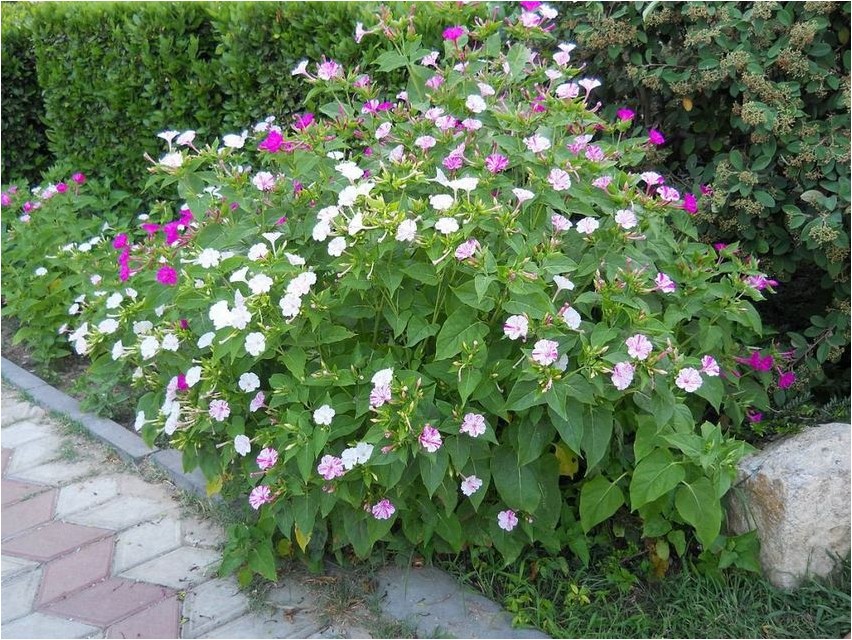
In the axils of the leaves of the upper branches, during the sunny hours of daylight, rather large flowers bloom, reaching a width of 4 to 6 centimeters. The shape of the flowers resembles a bell or a funnel. Delicate flowers with five purple petals are protected by a strong calyx of five semi-fused sepals. The calyx resembles a flower vase, the upper edge of which is formed in the form of sharp, triangular teeth. This natural vase can contain up to 6 flowers at the same time. They gradually, one after another, open their petals, turning flowering into a long-lasting event. Thus, flowering lasts throughout the summer months, holding part of the autumn until frost takes over.

Usage
Among the American aborigines there is one amazing Zuni tribe, which for 4000 years has been growing cultivated plants, such as corn. Their language is unlike any other American Indian language. From ancient times to the present day, they managed to preserve their language, customs, and gods, without succumbing to the “civilization” of the conquerors.
Living in kinship with nature gave them a lot of knowledge not only about cultivated plants, but also about wild representatives of the plant world, which they actively use in the fight against human ailments.
Among such plants is Mirabilis multiflora (“Mirabilis multiflora” or “Colorado four o” clock).
It turns out that the problem of “overeating” or, more simply, gluttony, is familiar not only to high-income nations. She did not bypass the Zuni tribe, who fight against her with the help of Mirabilis multiflorum.
To reduce a person’s appetite, women of the Zuni tribe add the root of the plant, ground to a powder, into flour and bake bread from this mixture. Such bread saturates the body faster, without leading a person to overeating. Such bread also helps to endure periods of food shortage in the tribe.
If a person nevertheless managed to overestimate the abilities of his digestive system and ate too much, then the patient is treated with an infusion of root powder by taking it inside the body.
During periods of crop failure, when there is nothing to feed people, they also come to the help of Mirabilis multiflorum, rubbing the bellies of hungry children and adults with an infusion of the roots.





