Motherwort varifolia
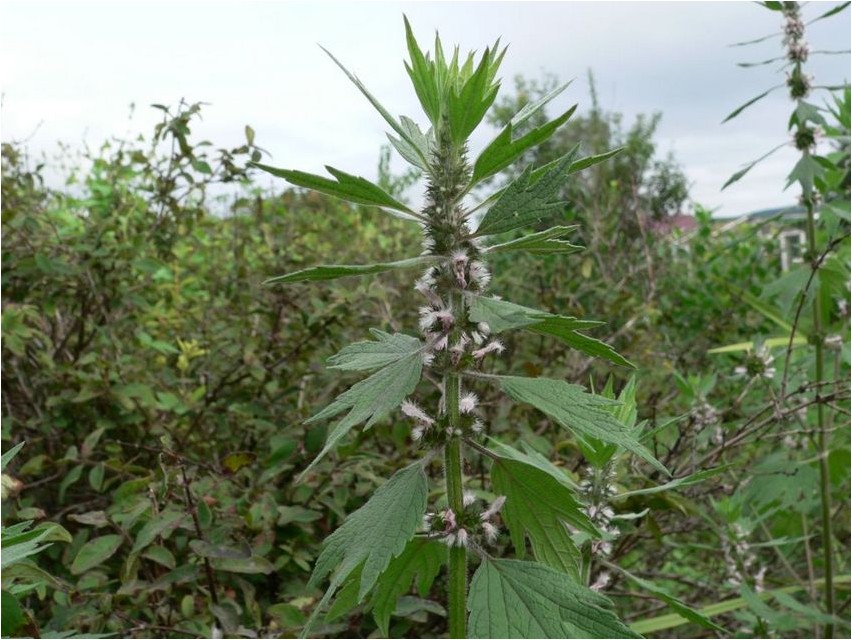
Motherwort is part of the family called Lamiaceae; in Latin the name of this plant would be Leonurus heterophyllus Sweet. (L. sibiricus auct., non L.).
As for the name of the motherwort family itself, in Latin it will be: Lamiaceae Lindl. (Labiatae Juss.).
Description of motherwort
Motherwort variegated is an annual or biennial herbaceous plant that is similar in appearance to wormwood. The height of the stem of this plant can reach approximately one meter, while the stem is endowed with grooved edges. The leaves of motherwort variegated can be either pinnately divided or palmately divided with rather deeply dissected lobes. The size of the corolla of this plant will be about nine to ten millimeters, and it will be colored in lilac-pink tones.
Under natural conditions, motherwort is found in the Daursky region of Eastern Siberia, as well as in the Amur region and Primorye of the Far East. For growth, this plant prefers sand, river pebbles and places near housing. It is noteworthy that motherwort is an excellent honey plant.
Description of the medicinal properties of motherwort
Motherwort varifolia is endowed with very valuable medicinal plants, and it is recommended to use the roots and grass of this plant for medicinal purposes. The term grass includes leaves, stems and flowers. The presence of such valuable healing properties is recommended to be explained by the content of coumarins and flavonoids, essential oil and tannins in the herb of this plant, while the seeds contain the alkaloid leonuridine.
As for traditional medicine, here this plant is very widespread. Traditional medicine uses all parts of motherwort varifolia for uterine bleeding. An infusion prepared from the herb and flowers of this plant is indicated for use as an obstetric aid, used to regulate menstruation, as well as to strengthen the muscles of the uterus after childbirth.

An infusion prepared from the seeds or herb of motherwort varifolia is used as a tonic, stimulant, and general strengthening agent, and will also restore strength, improve blood composition and circulation, and also promote spermatogenesis.
In the Amur region, the flowers and grass of this plant are used for epilepsy. A decoction based on motherwort seeds is indicated for use in glaucoma, and is also used as an antidiarrheal, diuretic and vision-improving agent.
A decoction prepared from the leaves and roots of motherwort is used as an antifever and also has the ability to stimulate appetite. The herb of this plant serves as an effective antipyretic and antidote. As for external use, the grass and seeds of motherwort are used as a wound-healing agent and used for various skin diseases.
To soften the mammary gland and abscesses, it is recommended to use compresses from the grass and flowers of motherwort, and also apply such compresses to abrasions and bruises.
At a temperature, it is recommended to use the following very effective remedy based on this plant: to prepare such a remedy, take a tablespoon of crushed dry herb in a glass of boiling water. This mixture is infused for two hours and filtered. Take this remedy based on motherwort varifolia three to four times, one-third of a glass.





