Eggplant
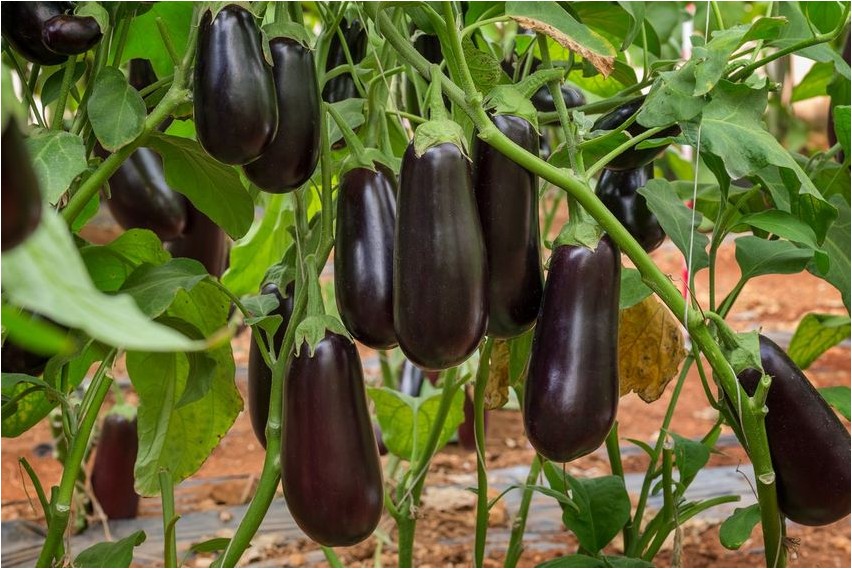
Eggplant, or badrijan (Solanum melongena), is a popular vegetable belonging to the genus Solanum.
History
Eggplant originated in India, from where it was brought to China. The Chinese cultivated eggplants as early as 500 BC.
General Characteristics
Eggplant is a perennial herbaceous plant. It has a tall stem, fairly large leaves, purple flowers, and round or pear-shaped fruits—purple, white, green, or striped.
Eggplant thrives in warm conditions, which is why it is common in southern Russia, Ukraine, Moldova, and Central Asia.

The most popular varieties are mid-season, including Almaz, Universalny, Batayskiy, Begemot, Bernard, and Donetsky Urozhnyy. All of these varieties are mid-season.
Care Instructions
Temperature. The most favorable temperature for plant development and growth is 22-28°C. Even a temperature drop to 20°C slows fertilization, fruit set, and development. If the temperature drops another five degrees, leaves will begin to fall and the plant will stop growing. If low temperatures persist, the plant will simply die.
Humidity. Eggplants are demanding not only of temperature but also of humidity. A decrease in humidity results in the loss of flowers and ovaries, and a halt in fruit growth. A lack of moisture is especially detrimental during fruit formation.
Soil. Eggplant grows well in highly fertile, structured soils. Cold, heavy soils, as well as soils near groundwater, are considered unsuitable.
Site selection. The site should be chosen taking into account the preceding crops. For example, eggplants grow best after onions, cabbage, melons, and root vegetables. The location must be changed because fungi and infections remain in the soil and threaten the eggplant yield. Therefore, eggplants can only be grown in the same location after two to three years.
Sowing. Typically, the vegetable is grown from seedlings. It is recommended to grow seedlings in pots. This allows for maximum preservation of the root system, allowing the plants to establish quickly.
Growing seedlings is possible both with and without picking seedlings (you can sow directly into pots). Eggplants are sown in the first weeks of March. The best temperature for seedling germination is 26-30°C. Seedlings can be expected on the seventh or eighth day after sowing. When the temperature drops to 20°C, germination is delayed. When sowing selected seeds, the yield improves significantly.
If you choose the picking method, the seeds are sown in boxes with nutritious soil — two parts of turf soil and part of humus plus a little sand. Leave a distance of three centimeters between the rows. The seeding rate is 10-12 grams per meter.
To water the crops, use water at room temperature. The top of the box is covered with plywood, film or glass and the temperature is maintained at 23-25°C. After the shoots appear, the boxes should be placed in a bright place and the temperature should be reduced for five to seven days. This measure allows the seedlings to grow stronger. As soon as real leaves appear, you can start picking. You can choose to use plastic or paper cups, or nutrient pots filled with a mixture (the same as for sowing).
Pots or glasses are placed in a box and filled with soil, leaving a couple of centimeters for watering and adding soil. Two seedlings can be planted in each pot, since eggplant seedlings do not stretch.
After sowing, it is important to monitor the soil moisture to prevent it from drying out. For irrigation, it is optimal to use heated water (18-20°C).
If seedling growth is delayed and the leaves are pale green, the plants need feeding. It is better to use organic fertilizers.
10-11 days before planting, you can begin to harden the seedlings by resorting to intensive ventilation. When grown in a room, seedlings are taken out to the balcony. In this case, wind and drafts should be avoided, and the temperature should not fall below 15°C.
Landing. As soon as steady warming sets in, eggplants are planted in open ground. As a rule, this happens after planting tomatoes, usually in mid-May.
Eggplants respond well to carefully cultivated, deeply plowed soil. Therefore, a few days before planting, do not be too lazy to loosen the soil. Plants are planted in a row at a distance of 26-30 cm. When planting, it is important to save a lump of earth from the cup. The introduction of humus is encouraged. Immediately after planting, the plants are watered. Two or three waterings are needed, and after the soil dries, the soil should be loosened between the rows and in the rows.
Watering. Eggplants need regular watering, otherwise the ovary will fall off, the fruits will grow slowly, and the plant will begin to hurt.
Feeding. It is necessary to feed eggplants during the most important periods for the life of the plant. For the first time, after the seedlings were planted in open ground, the eggplants took root and began to grow. Nitrogen fertilizers will help with this. After adding them, it is necessary to water the eggplants with clean water to avoid burns. The second feeding is necessary when fruit formation begins (with potassium and phosphorus).
Pest protection. Care should also be taken to protect against pests. The main enemy of the “little blue ones” is the Colorado potato beetle. The most effective way to get rid of beetles is by hand, and to do this in sunny weather. If there are too many beetles and larvae, it is better to treat with insecticides. The last stage of processing should be carried out three to four weeks before harvesting begins.





