Veronica officinalis
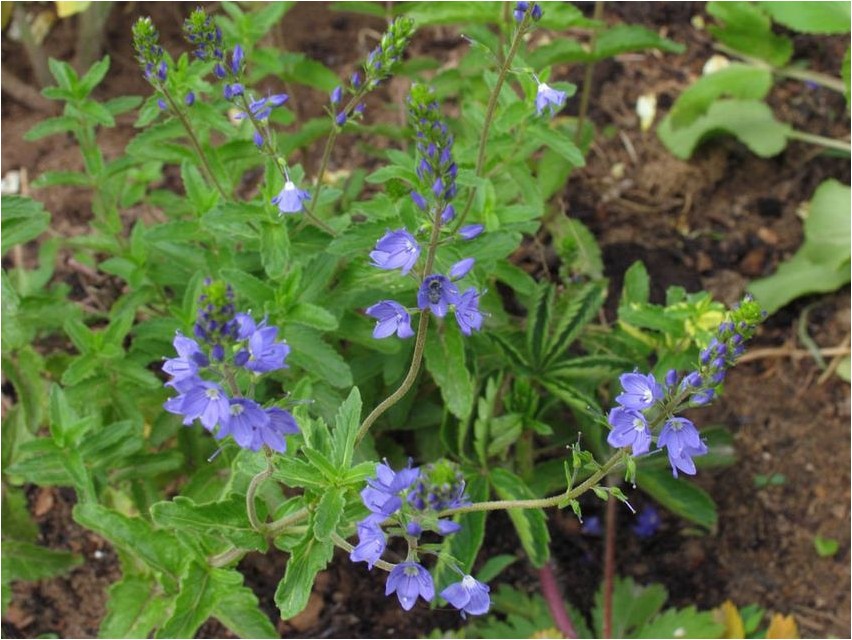
Veronica officinalis is part of the family called Noricaceae; in Latin the name of this plant is as follows: Veronica officinalis L.
As for the name of the family itself, in Latin it will be: Scrophulariaceae Juss.
Description of Veronica officinalis
Veronica officinalis is a perennial herbaceous plant with a creeping and pubescent ascending stem. The leaves of this plant are opposite and obovate, these leaves are on short petioles and have jagged edges. The flowers of the plant are quite small in size and painted in pale blue or blue tones with a lilac tint. The corolla of Veronica officinalis is spicate and four-parted, it is endowed with two stamens. The fruit of the plant is a two-lobed capsule.
Veronica officinalis blooms from June to July. The ripening of the fruits of the plant occurs in August-September. In natural conditions, Veronica officinalis can be found in the European part of Russia, Belarus, the Caucasus, Ukraine and Crimea. This plant prefers to grow in forests, clearings, meadows, forest edges, and sometimes the plant is found among shrubs.
Description of the medicinal properties of Veronica officinalis

It is noteworthy that the entire plant can be used for medicinal purposes. It is recommended to collect Veronica officinalis herb throughout the entire flowering period. The plant’s grass should be dried in rooms with good ventilation, and the grass should be spread in a fairly thin layer of three to five centimeters. This plant contains bitter substances, tannins, essential oils, flavonoids, glycosides, saponins, aucubin, veronicin, as well as traces of alkaloids and vitamins.
It is noteworthy that there was no official calling for this plant in scientific medicine, however, the plant is recognized as the official medicine of Western Europe. Veronica officinalis is capable of providing analgesic, anti-cold, anti-inflammatory, antitoxic, antiseptic, antifungal, hemostatic, wound healing and expectorant effects.
In folk medicine, an infusion of Veronica officinalis is used for various colds, coughs and bronchitis, laryngitis and bronchial asthma, as well as gastritis and pulmonary tuberculosis, tracheitis and gastric ulcers. An infusion of this plant is also recommended for diseases of the duodenum, bladder and kidney diseases, bleeding, diathesis, eczema, headaches, pyoderma, and scabies. For scabies, this infusion is recommended for internal use or as compresses, washes, and baths.
A decoction made from Veronica officinalis is used for a wide range of respiratory ailments, such as bronchitis, tonsillitis, and bronchial asthma. Moreover, this decoction is also effective for gout, rheumatism, and skin rashes. As a diuretic, this decoction is indicated for sand and stones in both the kidneys and bladder. Fresh leaves of common speedwell can be used to prevent sweaty feet. To quickly heal purulent wounds, it is recommended to apply crushed leaves to the affected areas. Furthermore, a paste made from the herb, as well as an infusion of the plant in vegetable oil, are effective for festering wounds, boils, and burns.





