Kurupita
Curupita (lat. Couroupita) is a deciduous evergreen tree belonging to the Lecitis family.
Description
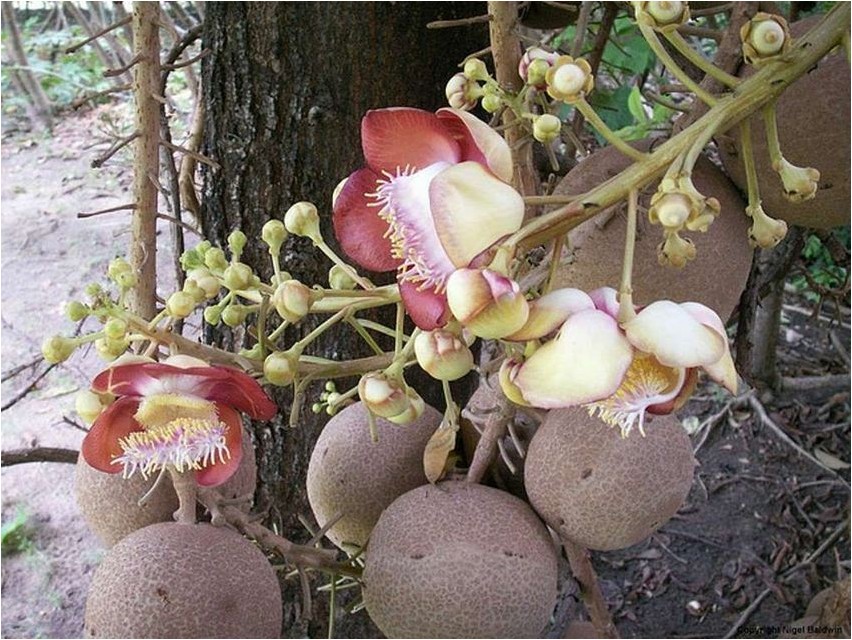
Kurupita is a deciduous evergreen tree, the height of which can reach as much as thirty-seven meters! In a word, this is a truly giant tropical tree with very strong dark brown bark. Lanceolate leaves of curupita are attached directly to the tips of the branches, and their length often reaches two meters, and large and rather fleshy, somewhat reminiscent of waxy curupita flowers are equipped with a huge number of stamens and boast a rather complex structure.
Among the most common varieties of curupita, it is customary to note the Nicaraguan curupita and the Guiana curupita. The latter is often called the “cannon tree” — perhaps because its mighty trunks are densely strewn with round, rich brown fruits reaching twenty centimeters in diameter throughout the year. Moreover, inside each fruit there is a jelly-like pulp with a very repulsive odor and a truly incredible amount of seeds. As it oxidizes in air, the juicy pulp of kurupita gradually turns bluish. And when these “cannonballs” fall from the trees, they also “explode” with a characteristic loud crack. The fruits usually begin to fall after full ripening, which takes about nine months.
The fragrant large flowers of this plant can be either orange or red. Pinkish or yellow shades are also slightly less common. Marvelous flowers appear throughout the year on drooping peduncles growing directly from the lower parts of the trunks. By the way, the development of flowers directly on the trunks of plants or on their thick branches can also be observed in a number of other trees (cupuacu, jackfruit, etc.) — this feature is called cauliflory. But sometimes, in order to wait for the curupita to bloom, you have to wait a long time — the first flowers may begin to appear only after four to ten years!
Where does it grow
Curupita is quite widespread throughout South America, from Panama to the vast expanses of the distant Amazon. This plant feels especially good in moist and humus-enriched soils, as well as in lowland rain forests.
Usage
Kurupita is most often planted in tropical gardens and parks, delighting the eyes of numerous visitors with its magnificent view. And in the wild, animals called peccaries enjoy feasting on its unusual fruits: by crushing the seemingly stubborn hard shells, they extract the juicy pulp from the treasured fruits and willingly eat it directly with the seeds. By the way, this greatly contributes to the further spread of the plant throughout the forest! Bats are also extremely partial to these unusual fruits, often flocking to the sweet aroma of luxurious flowers.

People can also eat the fruits of Curupita Guiana, but it is important to take into account that they can provoke allergic reactions. And in some African houses you can sometimes see fancy kitchen utensils that were made from the hard shells of ripened fruits.
Growing and care
Kurupita loves bright sunlight very much, so ideally it should be planted exclusively in sunny areas (in the worst case scenario, slightly shaded places are also suitable). This plant also simply loves humidified air and is extremely moisture-loving; accordingly, it is important to try to constantly keep the soil moist and provide regular abundant watering.