Fragrant bison
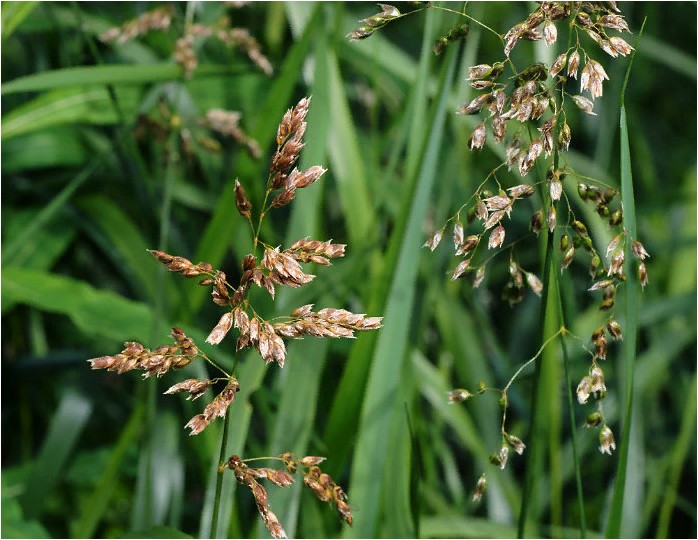
The fragrant bison is one of the plants of the family called cereals; in Latin the name of this plant will be as follows: Hierochloe odorata L.
As for the name of the fragrant bison family itself, in Latin it will be like this: Gramineae.
Description of the fragrant bison
Fragrant bison is also known by the following popular names: tomkovitsa, bitter grass, flat grass, chapolot and turovka. The fragrant bison is a perennial herbaceous fragrant plant, endowed with long rhizomes, the height of which will vary between twenty-five and seventy centimeters. The stems of this plant are smooth and bare. The leaves are flat, the basal leaves will be long-pointed, and the stem leaves will be bare, lanceolate-linear and equipped with a rather long membranous tongue. The inflorescence of the fragrant bison will be paniculate and ovoid, its length will be about ten to twelve centimeters. The spikelets are painted in golden-brown tones, they are shiny and ovoid, endowed with either two staminate flowers or one bisexual. The fruit of this plant is a grain.
Flowering of the fragrant bison occurs from late spring to early summer. Under natural conditions, this plant is found in the Far East, Western Siberia, the European part of Russia, Central Asia, the Caucasus, Kazakhstan, Belarus and Ukraine. For growth, the plant prefers places along river banks and forest edges, in damp meadows and on sandy soils along river banks, as well as in the mountains.
Description of the medicinal properties of sweet bison
The fragrant bison is endowed with very valuable healing properties, and for medicinal purposes it is recommended to use the herb of this plant, which includes panicles, leaves and stems. Such raw materials should be harvested from May to June.
The presence of such valuable healing properties is explained by the content of the coumarin glycoside in the plant, which will give the plant an aromatic smell. It is noteworthy that such a substance will be formed only when the plant is dried. In addition, the fragrant bison grass contains the following acids: melilotic, ferulic and coumaric. The rhizome of this plant contains coumarin and a coumarin compound called umbelliferone. Ascorbic acid is present in the leaves and panicles of this plant.

An infusion and vodka tincture of this plant’s herb are recommended for various chronic stomach ailments, as well as fever and pulmonary tuberculosis. They are also used to stimulate appetite and as an antiseptic. It’s worth noting that the rhizomes of this plant have a warming effect when taken internally.
It’s worth noting that sweet bison grass is also used in the liquor industry to prepare a rather aromatic liqueur called bison grass.
For pulmonary tuberculosis, the following rather effective remedy based on sweet bison grass is recommended: to prepare this remedy, take one tablespoon of dried bison grass and steep it for thirty minutes in one cup of boiling water in a sealed container. Afterwards, it’s recommended to strain the resulting infusion very thoroughly. Take two tablespoons of this sweet bison grass remedy three to four times a day, ten to fifteen minutes before meals. It’s important to remember that to achieve maximum effectiveness, you must strictly follow all preparation instructions, as well as all the rules for taking such a valuable remedy.
Bison grass: description, properties, and uses
https://www. youtube. com/watch? v=4NpLmrxm-kY





