Geranium rotundifolia
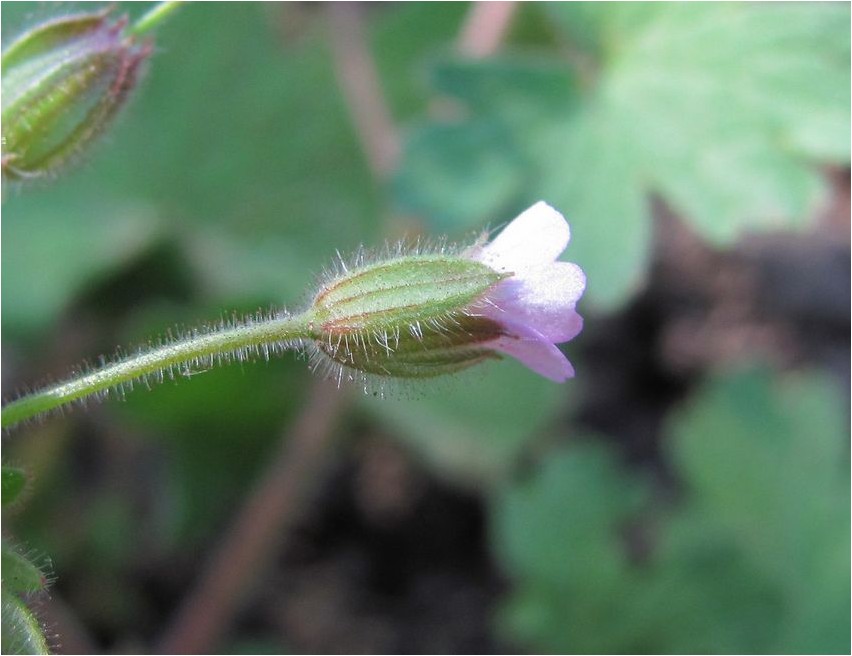
Geranium rotundifolium is one of the plants of the family called Geraniaceae; in Latin the name of this plant will be as follows: Geranium rotundifolium L.
As for the name of the round-leaved geranium family itself, in Latin it will be: Geraniaceae Juss.
Description of geranium rotundifolia
Geranium rotundifolia is an annual herbaceous plant. This plant will have several stems, which can be either ascending or straight, the height of the stems will be about twenty to forty centimeters. Such stems will be branched, they are densely covered with short soft hairs, which will be glandular at the top. The basal leaves of Geranium rotundifolia are numerous, they form a rosette, and will also die early. In outline, such leaves are rounded-reniform, while the width of the lower leaves can be about five centimeters. The length of the peduncles will be about five centimeters, while they will be endowed with two pedicels, the length of which will be about one to two centimeters. The sepals will be elliptical in shape, and they are also pointed. The sepals are endowed with three to five veins, they are hairy, and the length of the petals will be about five to seven millimeters; their color can be either purple or pink.
Geranium rotundifolia blooms from May to June. The ripening of the fruits of this plant occurs in July. Under natural conditions, this plant can be found in Moldova, the Baltic states, the Caucasus, and also in Central Asia. As for Ukraine, here the plant can be seen in the Carpathians and the Dnieper region, and in the European part of Russia, round-leaved geranium is found in the Baltic, Black Sea and Ladoga-Ilmen regions. For growth, this plant prefers pebbles, gravelly slopes, gardens, shrubs and trash areas.
Description of the medicinal properties of geranium rotundifolia
This plant is endowed with very valuable healing properties, and the juice of the leaves and grass should be used for medicinal purposes. The concept of grass includes the stems, flowers and leaves of this plant. The plant contains nitrogen-containing compounds, tannins and gamma-butyric acid. At the same time, the stems and leaves of geranium rotundifolia contain sucrose, as well as the following tannins: isogeraniin, geraniin, lycosides of hexahydroxydiphenic, dehydrohexahydroxydiphenic and gallic acid. The leaves of this plant contain kaempferol and quercetin.
An infusion and decoction of the herb of this plant is recommended to be used as a hemostatic and astringent, and also based on it, baths for children with diathesis are very effective. In Tajikistan, the juice of the leaves of this plant is used to treat acne.

For furunculosis, it is recommended to use the following remedy: to prepare it you will need to take one tablespoon of round-leaved geranium per glass of boiling water. This product should be infused for about one to two hours, and then strained thoroughly. Take this remedy approximately one third of a glass three to four times a day before meals.
For bathing children with diathesis, the following remedy will be very effective: take one hundred grams of crushed herb of this plant per liter of water. Then this mixture should be boiled for about three to four minutes over fairly low heat. After this, the mixture is infused for one hour and then filtered thoroughly. It is worth noting that this does not exhaust the medicinal capabilities of this plant.





