Rhododendron small-leaved
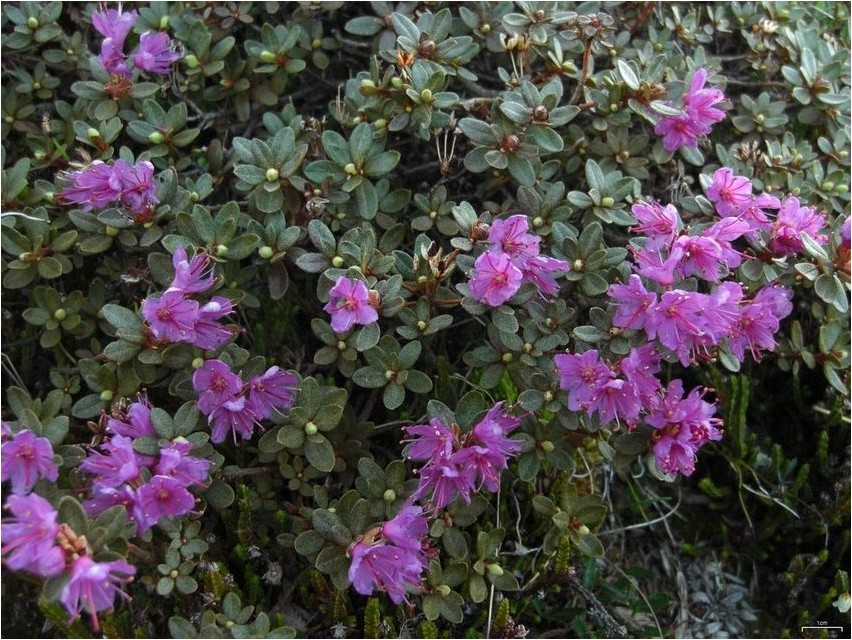
Small-leaved rhododendron is one of the plants of the family called Ericaceae; in Latin the name of this plant will be as follows: Rhododendron parvifolium Adams.
As for the name of the small-leaved rhododendron family itself, in Latin it will be: Ericaceae Juss.
Description of small-leaved rhododendron
Small-leaved rhododendron is a shrub or evergreen shrub, the height of which will reach one meter. Such a plant will be compact and branched; it can be either pressed to the ground or straight. Young branches of small-leaved rhododendron are densely iron-rusty, while older branches will be endowed with dark gray bark. The leaves of this plant, in turn, are elliptical, their length is about eleven to twenty centimeters, and the width will be equal to four to seven millimeters; such leaves will be leathery and overwintering. There are only two to four flowers of small-leaved rhododendron, they are collected in a shield, the corolla of this plant is open-bell-shaped, it will be painted in white or purple-pink tones. The capsule of this plant will be rusty-ferruginous in color and oval in shape.
Small-leaved rhododendron blooms from May to July. Under natural conditions, this plant is found in the Far East, Eastern Arctic and Eastern Siberia. As for its general distribution, this plant can be found in North America, Korea, Manchuria, Mongolia and the Bering Sea. For growth, this plant will prefer swampy birch, pine and larch forests, and in addition to char and swamps in the mid-mountain and upper-mountain zones.
Description of the medicinal properties of small-leaved rhododendron
Small-leaved rhododendron is endowed with very valuable healing properties, and it is recommended to use the leaves of this plant for medicinal purposes.
The presence of such valuable medicinal properties can be attributed to the tannins, phenols, sitosterol, and triterpenoids found in this plant. It is noteworthy that aqueous and hydroalcoholic extracts from the leaves of Rhododendron microphyllus exhibit antibacterial activity against diphtheria bacilli, typhoid bacilli, streptococci, and Staphylococcus aureus. Animal experiments have shown that this plant has a normalizing effect on the digestive system, increases diuresis, and stimulates the cardiovascular system.

Rhododendron microphyllus is widely used in folk medicine. Traditional medicine recommends using a decoction made from the leaves of this plant as a diuretic. The following herbal remedy is recommended as a diuretic: to prepare this remedy, take two tablespoons of dried, crushed small-leaved rhododendron leaves per cup of water. The resulting mixture should first be boiled for three to four minutes, then steeped for two hours, after which the herbal remedy should be thoroughly strained. Take two tablespoons of this herbal remedy two to three times a day, regardless of meals. When used correctly, the positive effect is noticeable quite quickly.
Small-leaved rhododendron vs. Daurian rhododendron – which is more beautiful?





