Daikon
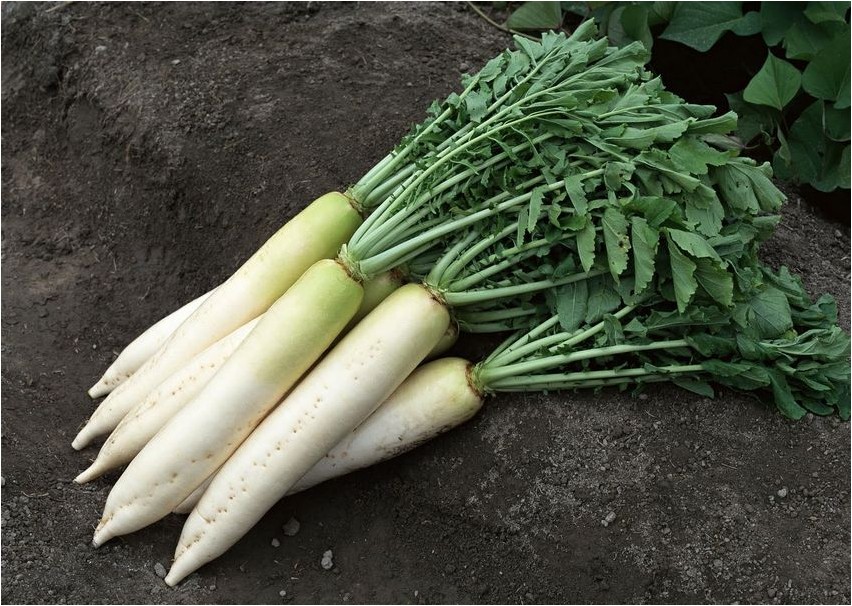
Daikon (Latin: Raphanus) is a vegetable crop; a root vegetable of the Brassicaceae, or Cruciferae, family. Other names include white or Chinese radish. Daikon is considered to be native to Southeast Asia.
Currently, the plant is widely cultivated in Korea, Japan, China, and Taiwan. It has only recently been introduced to Russia. Daikon is known to have been selectively bred from Asian radish varieties. Unlike radishes, the plant does not contain mustard oils, has a mild aroma, and a pleasant, sweet taste.
Crop Characteristics
Daikon is a biennial plant that forms a spreading or raised rosette of leaves and a root in the first year, and a stem with a branched peduncle and purple flowers in the second. The leaves are large, smooth or pubescent, and deeply dissected. The root vegetable is round, cylindrical, conical, elliptical, spindle-shaped, or serpentine, and can be white or light green depending on the variety. The root weight is 0. 3-2 kg. The seeds are large and light brown.
Daikon is a cold-hardy plant; the seeds germinate at temperatures of 3°C (3°F), while mature plants can withstand frosts down t o-4°C (24°F). The optimal growing temperature for daikon is 15-25°C (59-77°F). The growing season lasts 60-120 days.
Growing Conditions

Daikon is a plant characterized by a strong photoperiodic response; more precisely, the crop responds to the length of daylight. When sown in early spring, daikon begins to shoot too quickly, resulting in small, tasteless roots. In central Russia, the crop should be sown in mid-June to early July. Daikon isn”t picky about soil conditions, but it thrives in light, fertile, well-drained, peaty-humus or peaty-soddy soils with a neutral pH. Heavy clay soils are not suitable for growing daikon.
Propagation and Planting
Daikon is propagated by seed. Sow in open ground in early June for summer consumption and early July for winter storage. Roots from June sowings have a poorer shelf life than those from July sowings. The growing site is prepared in the fall: the soil is dug to a depth of 40-50 cm, rotted compost, urea, superphosphate, and potassium salt are added. In the spring, the beds are thoroughly loosened with a rake and fertilized with nitrophoska.
Sow the seeds in pre-moistened soil, then mulch with dry soil and cover with plastic film. Woven materials should not be used as they do not protect against pests and do not retain moisture in the soil. Sowing is done in two rows. The seeding depth is 2-3 cm. The distance between plants should be 20-25 cm, and between rows 60-70 cm. Plants should be thinned out if necessary.
Care
In general, caring for daikon is not difficult. Plants need regular watering, weeding, fertilizing and loosening the soil between the rows. After watering, it is advisable to mulch the soil in the near-stem zone with peat; this procedure will prevent the formation of crusts and compactions. Fertilizing is carried out twice per season; complex mineral fertilizers are ideal for this purpose.
Pest Control
Pest control is one of the most important activities in crop care. The leaves of plants are often eaten by slugs; for prevention, the soil around the plant is treated with approved molluscicides or powdered superphosphate is scattered. Cruciferous flea beetles are dangerous for daikon; they can destroy seedlings in 1-2 days. To prevent this from happening, immediately after sowing the ridges are covered with lutrasil or agril and kept in this state until 2-3 true leaves appear on the seedlings. If aphids or thrips are found on plants, they are sprayed with infusions of tobacco dust, celandine, hot pepper or tansy.
Harvesting and storage
Harvesting begins 50-70 days after sowing. Overgrown root vegetables lose their taste. Long root crops, completely immersed in the soil, are dug up with a shovel, others are pulled out by the tops. The root crops are cleared of soil, dried in the open sun, and the tops are cut off, leaving short petioles. Daikon is stored in basements or cellars in boxes under film. You can also store root vegetables in sand at a temperature of 0-3C.
Korean pickled Daikon radish for meat
Daikon daikon