St. John’s wort
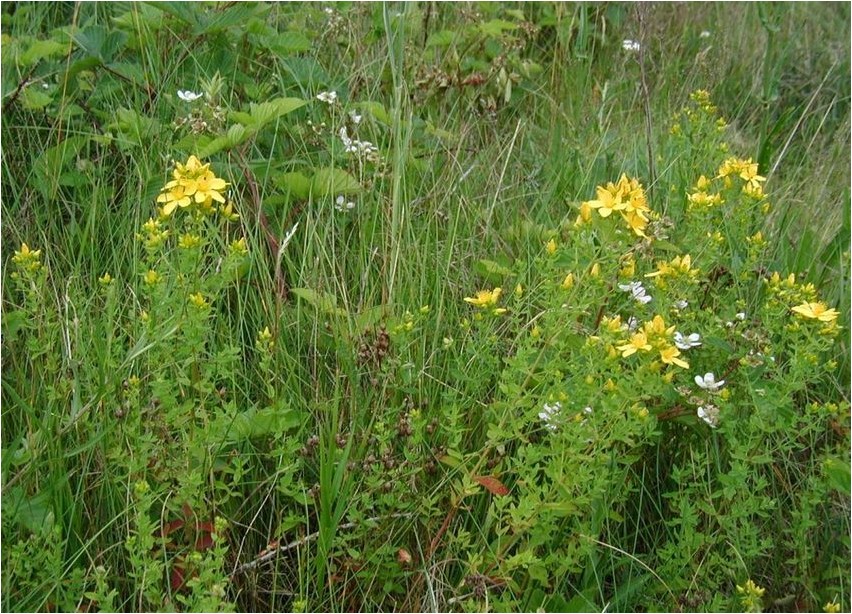
St. John’s wort is one of the plants of the family called St. John’s wort; in Latin the name of this plant will be as follows: Hypericum perforatum L.
As for the name of the St. John’s wort family itself, in Latin it will be: Hypericaceae Juss.
Description of St. John’s wort
St. John’s wort is a perennial herbaceous plant endowed with a very small branched rhizome. From such a rhizome, several smooth dihedral stems grow annually, which will be erect and colored in reddish-brown tones. The leaves of this plant will be opposite, they are entire, oblong, sessile, simple and endowed with translucent glands. Basically, the flowers of St. John’s wort are located in the upper part of the stem; such flowers will be quite large and they are collected in wide paniculate corymbose inflorescences. The fruit of the plant is a multi-seeded triangular capsule that will open with three doors.
Flowering of St. John’s wort occurs in the period from June to August, while the ripening of the fruits occurs in September-October.
Description of the medicinal properties of St. John’s wort
St. John’s wort is endowed with very valuable healing properties, and it is recommended to use the herb of this plant for medicinal purposes. The grass should be harvested during flowering, and the tops of the plants, approximately twenty-five to thirty centimeters long, are cut off. Such raw materials can be stored for three years.
The presence of such valuable healing properties is due to the content of biologically active compounds in the herb of this plant. In this case, the main active ingredients will be photoactive condensed anthracene derivatives. In addition, the plant contains essential oil, tannins, carotene, saponins, ascorbic and nicotinic acids, choline, traces of alkaloids and trace elements such as zinc and manganese. It should be noted that the juice from fresh St. John’s wort herb will contain one and a half times more valuable substances than the herb tincture.

The herb of this plant has hemostatic, analgesic, antimicrobial, astringent, wound-healing, choleretic, stimulant, antiseptic, and antispasmodic properties. Preparations based on this plant have appetite-improving properties, stimulate the excretory activity of various glands, improve tissue regeneration, and have a calming effect on the nervous system.
Crushed fresh leaves of this plant are recommended for application to wounds to promote faster healing. Crushed herb, infused in vegetable oil and then mixed with turpentine, is recommended for rubbing on joints affected by rheumatism.
An alcohol tincture diluted with water is recommended for rinsing the mouth to eliminate foul odor. The pure tincture should be applied to gums if they are inflamed. In addition, St. John’s wort is found in a variety of medicinal infusions, including antirheumatic, diuretic, and astringent ones. Fresh St. John’s wort is perfectly acceptable for consumption in salads, and in summer, these parts of the plant can also be used as a spice.
St. John’s wort can increase animals’ sensitivity to sunlight: if an animal consumes large amounts of the plant, severe itching will occur, followed by nervous system depression.





