Soft bedstraw
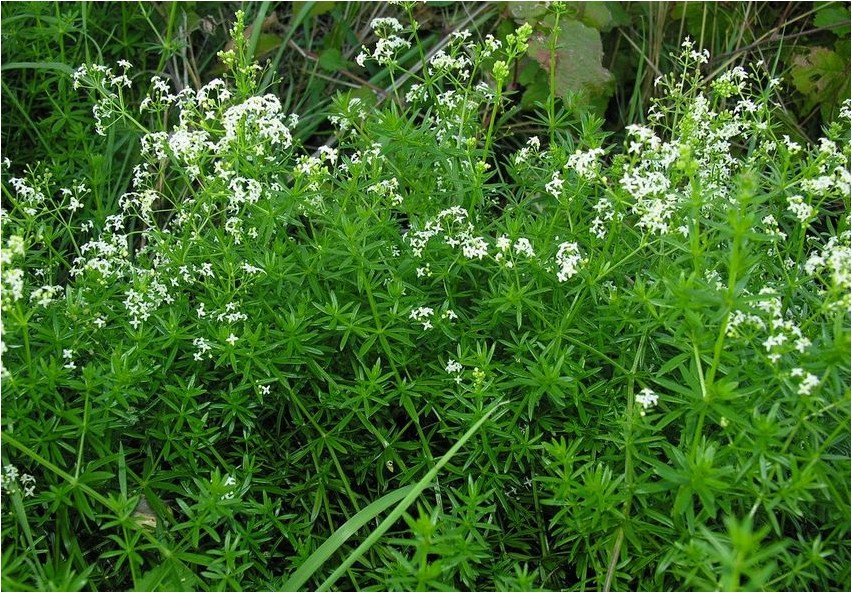
The soft bedstraw is one of the plants of the family called rotational plants; in Latin the name of this plant will be as follows: Galium moolugo L. (G. pseudomollugo Klok.).
As for the name of the soft bedstraw family itself, in Latin it will be: Menyanthaceae Dumort.
Description of soft bedstraw
Soft bedstraw is a perennial herbaceous plant, the height of which will fluctuate between twenty-five and one hundred and twenty-five centimeters. The stems of this plant will be branched, tetrahedral and somewhat ascending. The leaves of the soft bedstraw are found in whorls of six to eight pieces, they are oblanceolate or linear-oblong, their length reaches two centimeters, and their width is approximately two and a half to four millimeters. Such leaves will be endowed with a pointed point and taper towards the top and base. The inflorescence of soft bedstraw is a terminal spreading panicle, endowed with deflected branches, and the peduncles are branched. The flowers of this plant are painted white and are on rather short stalks, and the width of such flowers is about three millimeters. The lobes of the corolla of soft bedstraw are endowed with a long point, and the anthers will turn black. The fruit of this plant is fractional, its width is less than one millimeter.
Soft bedstraw blooms in the summer. Under natural conditions, this plant is found in Western Siberia, Ukraine, Moldova, Belarus, the European part of Russia, and is also found as an alien plant in the European Arctic. For growth, this plant prefers the banks of rivers and lakes, rocky and dry slopes, meadows, light dry edges of pine and oak forests, clearings and clearings.
Description of the medicinal properties of soft bedstraw
Soft bedstraw is endowed with very valuable healing properties, and it is recommended to use the herb of this plant for medicinal purposes. The term grass includes flowers, stems and leaves.

The presence of valuable healing properties is recommended to be explained by the content of coumarins, steroid saponins, anthraquinones, tannins and flavonoids in the rhizomes of this plant. The aerial part of this plant contains vitamin C, scopoletin, alkaloids, essential oil, saponins, iridoids, phenolcarboxylic acids and chlorogenic acid.
As for traditional medicine, here this plant is very widespread. Tea made from the herb of this plant is recommended for heart disease. As part of the collection, a decoction based on the herb of soft bedstraw is used for hypertension, and infusions are considered an effective sedative for excited children. Rubbing with soft bedstraw tincture is used for overworked hands and for osteoalgia.
An infusion based on the herb of this plant is indicated for use in various gynecological diseases and kidney diseases, and is also used for malignant tumors, scurvy, scrofulosis, gout and epilepsy. In addition, this infusion is used as an antispasmodic, sedative and astringent. The tea in the mixture is indicated for use in various stomach diseases, including chronic gastritis.
It is noteworthy that the experiment proved that an infusion based on the herb of this plant will exhibit very effective antispasmodic properties. In addition, soft bedstraw is also endowed with milk-clotting properties. In some countries, the herb of this plant was used to make cheese.





