Feijoa
Feijoa (Latin: Feijoa) is a small evergreen tree belonging to the Myrtle family.
History
Feijoa was first discovered by Europeans in the late 19th century, when they encountered these unusual fruits in Brazil. They owe their interesting Latin name to their discoverer, João da Silva Feijoa, who was the director of the Museum of Natural History at the time.
Description
Feijoas are evergreen, spreading shrubs or small trees, capable of reaching a height of four meters. Their root system is very shallow in the soil and is characterized by compactness and dense branching (like many other moisture-loving plants). Feijoa trunks are always covered with rough, greenish-brown bark.
The entire, leathery leaves of the plant are always quite stiff and crosswise opposite. They are all oval in shape and sit on short petioles. They are dark green and smooth above, while the underside is pubescent and greenish-gray. They are often pendulous and characterized by pinnate venation.
The solitary, axillary, tetramerous flowers can be paired or gathered into corymbose inflorescences of several. They are usually white at the edges and pinkish toward the center. All flowers are bisexual, self-sterile (some varieties are partially self-fertile), and have numerous stamens (from fifty to eighty). They are usually pollinated by insects. Flowering itself occurs in May and June (and November-December in the Southern Hemisphere). In the tropics, flowering can be either remontant (continuous) or intermittent. However, mass flowering in most cases lasts no more than three weeks. Feijoas are characterized by a fairly high ovary drop rate, with the useful ovary rate typically being no more than 15-17%.
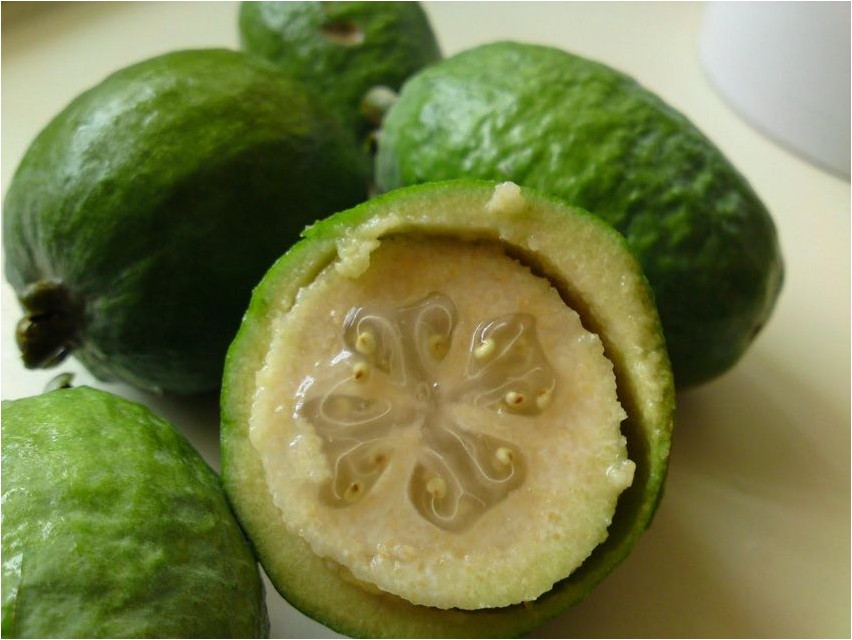
Feijoa fruits are fairly large, juicy, fleshy berries with a flavor and aroma reminiscent of kiwi, pineapple, and strawberry. The fruits are almost always dark green in color, and their shape can vary from broadly round to elongated oval. Less commonly, you can encounter cube-shaped feijoas. The length of the fruits ranges from two to five centimeters (much less often up to seven), and the diameter ranges from one and a half to three to four centimeters (rarely up to five). Most fruits weigh between fifteen and sixty grams, but feijoas weighing 15 to 120 grams are occasionally encountered.

Cloned (rooted, grafted) plants begin to bear fruit approximately in the third or fourth year, and seedlings only after reaching six or seven years of age.
Usage
Feijoa is actively used in cooking — these fancy fruits are added to salads, and jams, preserves, lemonades and compotes are also prepared from them. In addition, peeled fruits are often ground and combined with sugar or honey — this mixture can be consumed raw or used as a filling for baked goods.
Feijoa also occupies an important place in dietary nutrition. By the way, these fruits are real champions in iodine content.
Growing and care
Feijoa is not particularly demanding on soils. However, this crop will grow best on a mixture of humus, turf soil and sand. From time to time, feijoas need to be replanted — in the first two to three years this is usually done annually (always keep a ball of earth and do not try to bury the plant too much), and then the plants are replanted every three years.
When hot weather sets in, feijoas are sprayed with water once a day (water at room temperature is used for this purpose). In summer, this crop should be watered abundantly, and in winter — moderately. In addition, in spring and summer it also needs to be fed.