Lunnaria
Lunaria (Latin: Lunaria) is a beautifully flowering, winter-hardy plant from the Brassicaceae family.
Description
Lunnaria is a sun-loving, shade-tolerant plant that can be an annual, biennial, or perennial. This beauty typically grows between half a meter and a meter tall.
Lunnaria is characterized by a very unusual and even quite original foliage structure: its lower leaflets are usually serrated and petiolate, while the upper ones are sessile.
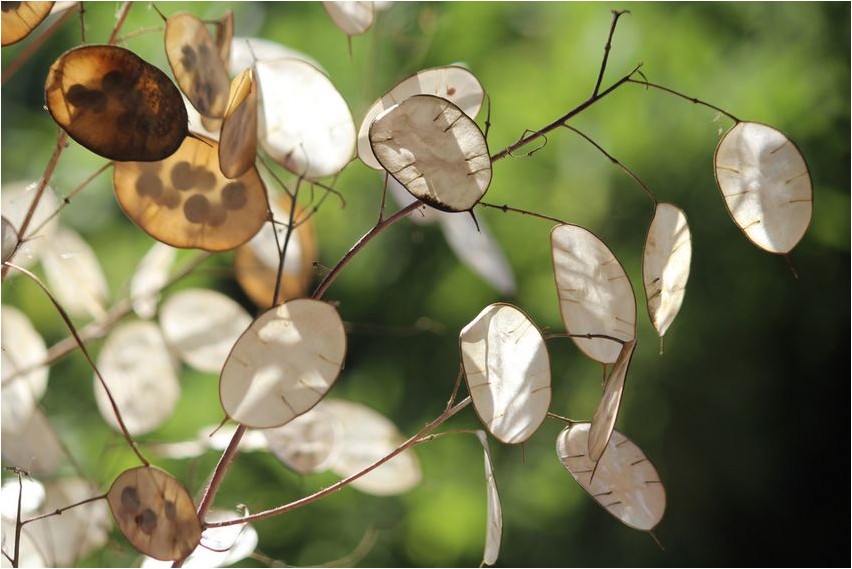
Lunnaria”s transparent “leaves” resemble tiny coins or mini-moons, which is why this plant is often called “silver ruble.” Its flowers exude a delicate and pleasant fragrance. All Lunnaria flowers are gathered in graceful, small inflorescences, which can be lilac, purple, or white. Lunnaria fruits are relatively large pods with translucent walls, resembling the moon in shape.
Currently, two species of Lunnaria are recognized: Lunnaria annua and Lunnaria revivifera.
There is an incredibly beautiful legend about the origin of this amazing plant: supposedly, Queen Moon, seeing myriad flowers on Earth, decided to descend and examine them more closely. Enchanted by the unprecedented beauty of these flowers, Queen Moon sat by them until morning, and before returning to the heavens, she decided to pick some of the wondrous flowers and scatter them across the sky alongside the stars. However, along the way, the bouquet in the Queen”s hands accidentally spilled, and she returned home without it. However, the flowers that fell to the ground acquired a very unusual appearance, resembling the moon. Since then, Queen Moon has periodically visited them during their blooming season. Where it grows

Lunnaria is quite common in central and southeastern Europe. It”s especially common in forests, but this beauty also thrives in parks and gardens, as well as in home gardens.
Uses
Lunnaria is most often planted in mixed borders or group plantings. It”s also equally popular for creating striking winter bouquets. If you remove the thin outer gills from the dried pods, all that remains are the finest oval, pearlescent partitions. These are what make a magnificent decoration for dried bouquets, and they are the main decorative feature of lunnaria!
Cultivation and Care
Annual lunaria is completely undemanding to soils. At the same time, it will grow best in open areas well lit by the sun, however, it also feels very good in light partial shade. But for growing perennials, a semi-shady or shady location would be most preferable. As for soils, well-moistened, deeply cultivated and fairly loose soils are more suitable for perennials.
Lunnaria is unpretentious in care — water it moderately and periodically pamper it with good fertilizing. At the same time, she does not like transplants — this plant is endowed with the ability to grow quite happily in one place for a long time.
Lunnaria propagation usually occurs through seeds. As a rule, annual plants are planted in the ground in summer or late spring — in this situation, they will delight you with their magnificent flowering already in May or June in the second year of life. And if you sow them for seedlings back in March, then Lunnaria will bloom in the first year!
As for all kinds of pests and ailments, Lunnaria is very resistant to them, although it is extremely rare that it can still be attacked by voracious psyllids.
Journey to the Moon — Ping Pong
Lunnaria lunnaria