Sainfoin
Sainfoin (lat. Onobrychis) is a genus of nutritious perennial plants growing in pastures with calcareous soil, classified by botanists as a member of the legume family (lat.
Fabaceae). The healing properties of some species of the genus, which promote the health of animals that feed on the grass of these plants, make them attractive for use as feed for cattle and sheep. The rich composition of useful substances in plants of the genus also helps in healing human ailments.
What’s in your name
The Latin name of the genus “Onobrychis” was borrowed by botanists from the language of Ancient Greece, in which similar plants were eaten with appetite by donkeys. This love of donkeys for the plant gave rise to the Greeks calling the grass a combination of two words, the meaning of which is translated as “devoured by donkeys.” Botanists, giving a name to a plant known since ancient times, did not invent anything new, and therefore put two Greek words in their original sound into the Latin name, obtaining such a complex Latin word “Onobrychis”, which in the Russian version sounds like “Sainfoin”.
Despite the fact that some species of the genus have armed their complex leaves with sharp thorns, and the bean pods of a number of species look like bristling hedgehogs, sheep and cattle continue to happily eat the grass of plants of the genus Sainfoin. This is due to the high nutritional value of the grass and the fact that, unlike many legumes, Sainfoin herbs do not cause bloating in animals, and also have anthelmintic properties, thereby reducing problems with livestock regarding the presence of parasitic worms in their digestive organs.
Description
Plants of the genus Sainfoin typically have a tap root that penetrates deep into the soil, which allows them to easily withstand periods of drought.
Among the plants of the genus there are small shrubs, subshrubs and herbaceous plants growing on almost all continents of the planet.

The alternate compound leaves have stipules and consist of oblong to linear leaflets, arranged in pairs along the length of a common petiole. There can be from 6 to 14 such pairs on one petiole. In a number of species, the common petiole ends with a sharp spine.
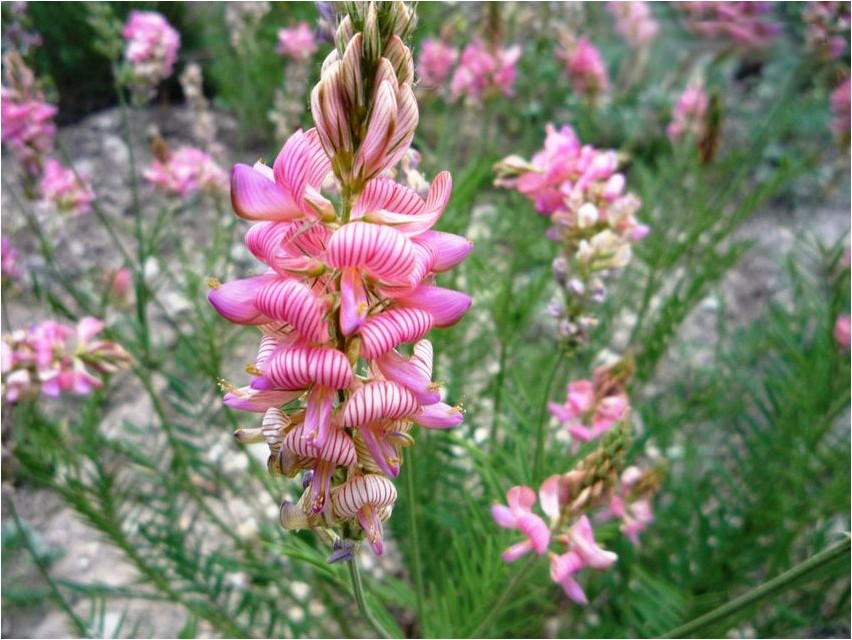
In the axils of complex leaves, flower stalks with inflorescences in the form of spikes or brushes are born. The inflorescences are formed by moth-type flowers pollinated by bees. Whitish, pink, yellowish or purple flowers adorn the plants from June to October.
The hemispherical, flattened bean pods of many species are armed with noticeable spines or bristles, with which they cling to the fur of grass-eating animals, using them as a means of transport to expand their territories. One or two seeds are buried inside the bean.
Varieties
The genus includes more than a hundred species of plants. Here are a few of them:
* Sainfoin (lat. Onobrychis viciifolia) is the most common species.
* Mountain sainfoin (lat. Onobrychis montana)
* Unarmed sainfoin (lat. Onobrychis inermis)
* Common sainfoin (lat. Onobrychis vulgaris)
* Sandy sainfoin (lat. Onobrychis arenaria)
* Sainfoin Vasilchenko (lat. Onobrychis vassilczenkoi)
* Slender sainfoin (lat. Onobrychis gracilis).
Usage
Plants of the sainfoin genus are excellent honey plants and provide bees with pollen for nutrition.
The high nutritional properties of the plants make them an important food for heavy draft horses, a sort of French Percheron. In addition, the grass of plants of this genus does not provoke bloating in ruminants, which often happens when eating other plants of the legume family. In addition, plants of the sainfoin genus protect animals from volvulus and parasitic worms. All these properties help animals grow healthy and gain weight faster.
Some types are used in traditional medicine.