Pomelo
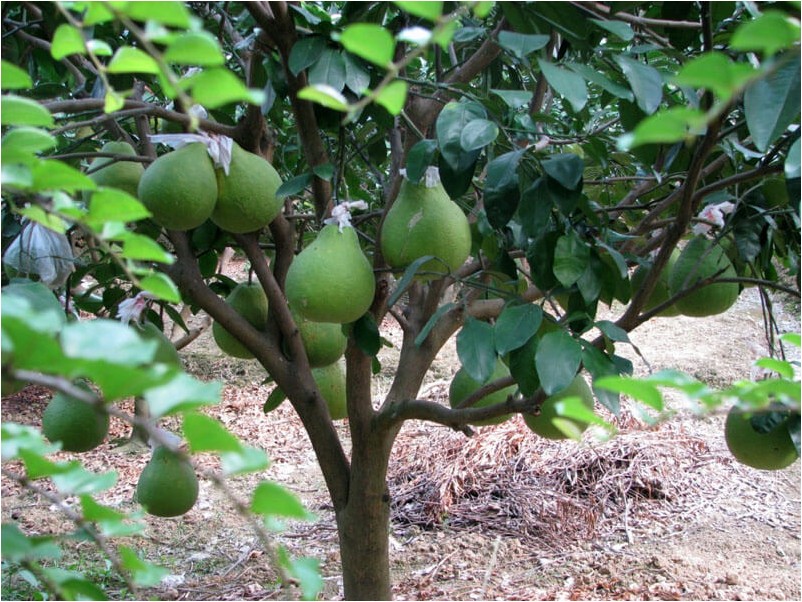
Fruit and berry crops, Pomelo (lat. Citrus maxima or Citrus grandis) is a species of fruit trees of the Citrus genus of the Rutaceae family. Other names are sheddock or pompelmousse.
Southeast Asia is considered to be the birthplace of the plant. In Europe, they learned about this wonderful fruit crop in the 14th century. Today, pomelo is cultivated in India, Indonesia, Japan, Vietnam, as well as in Israel and Tahiti. The crop is also grown in the USA, but in small quantities. In Russia and neighboring countries, pomelo is cultivated as an indoor crop.
Characteristics of culture
Pomelo is an evergreen tree with a spherical crown and reaching a height of 14-15 m. The leaves are quite large, green, leathery, elliptical, with a pronounced central vein. The flowers are medium-sized, up to 7 cm, solitary or collected in inflorescences of 2-10 pieces. The fruit is round or pear-shaped, color varies from light green to yellow or orange. The fruit is covered with a thick peel, inside it is divided into equal or unequal shares, compacted with a hard white partition. The pomelo fruit is one of the largest among citrus fruits. Under natural conditions, pomelo reaches a weight of 10 kg. The taste of the pulp is sweetish with sourness and light notes of bitterness.
Popular varieties
*Khao paen is a variety that has been cultivated in Thailand for 160 years. Representatives of the variety have a greenish-yellow spherical fruit. The peel of the fruit is wrinkled, 1-2 cm thick. The flesh of the fruit is white, juicy, sweet with sourness, the taste of bitterness is practically absent.

*Khao phuang — the variety is artificially bred. Representatives of the variety produce pear-shaped fruits with a “neck”, with a diameter of about 12-13 cm. The skin is green, shiny, smooth. The pulp is juicy and has an excellent taste with sourness and no bitterness. The variety is cultivated in huge quantities in Thailand, as well as in the USA.
*Thongdi is also an artificially bred variety. The fruits are spherical, up to 15 cm in diameter. The peel is relatively thin. The pulp is pink, juicy, sweet. Representatives of the variety develop without problems even in the most unfavorable conditions for all citrus fruits.
Growing conditions
Light for growing pomelo is preferable to be bright and diffused; direct sunlight is undesirable. In spring and summer, plants are placed on the balcony or in the garden, but with the onset of cold nights they are brought indoors. The soil mixture for the crop must be loose, moist, and fertile. Under natural conditions, pomelo develops well on substrates consisting of limestone, sand, clay and soil enriched with salts.
Subtleties of propagation and planting
Pomelo is propagated by seed and vegetatively, or rather, by air layering and cuttings. The seed method allows you to get more powerful trees, but you will have to wait several years for them to bear fruit, and they do not grow quickly. Specimens obtained from cuttings and layering develop very slowly, but under optimal conditions and proper care this difference will not be noticeable.
The seeds are removed from the fruit and immediately planted in pots with a substrate composed of humus and coarse sand. Planting depth is 1-1. 5 cm. After planting, the substrate in the pots is watered abundantly. Shoots appear in 30-35 days. Often several sprouts are formed from one seed. If the pomelo was planted in seedling containers, in the phase of two true leaves they are picked, but this is done very carefully so as not to damage the root system.
It is much more difficult to propagate the crop by air layering than other representatives of the Citrus genus. A pomelo propagated in this way blooms the very next year. The lowest branch with well-developed side shoots is selected from the tree, then a circular cut is made 20 cm below the last branch and bent to a container cut in half and placed next to the pot where the mother bush is grown. The ringed area should be located in the middle of the container. Both halves of the container are fastened with wire. This way, the fastened pot will hang on the branch.
The container should be filled with sawdust, moss, small shavings and turf-leaf humus, laid in layers. The cuttings are separated from the mother plant only when the growth of young shoots stops. It is important to regularly feed the layering with ammonium nitrate solution. Instead of a pot, it is not forbidden to use ordinary plastic film with the same soil mixture, but before planting the cuttings, they are carefully treated with growth stimulants. The cuttings are separated in two steps: the first — under the pot when separated from the mother plant, the second — when the roots are freed from sawdust, moss and soil. Transplant the seedling into a separate pot filled with nutritious soil.
Care
Regular watering using settled, rain or melt water, you can also use river water. Compliance with the recommended regimen is mandatory. The soil in the pot should not be over-watered or allowed to dry out. The quantity and quality of watering depends on the temperature and humidity of the room, as well as on the age of the plant and the pot used to grow it.
It is also necessary to regularly spray the tree, because this procedure reduces the evaporation of water from the leaves, which is important for the normal functioning of the root system. Feeding pomelo is carried out during the period of active growth, and especially during flowering and fruiting. In addition to complex mineral fertilizers, it is recommended to add macroelements such as iron, magnesium, sulfur, calcium, etc.





