Gentiana procumbens
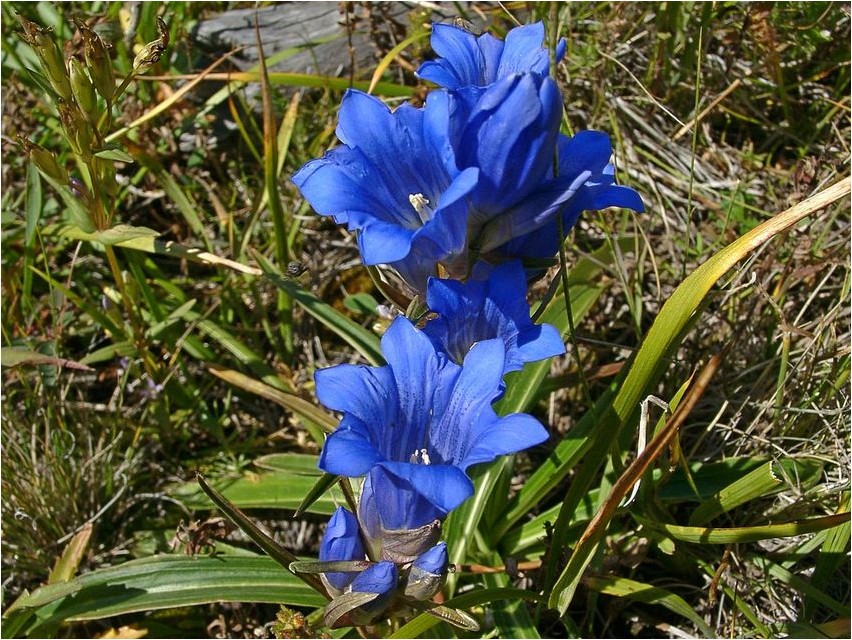
Gentiana procumbens is a member of the Gentianaceae family. Its Latin name is Gentiana decumbens L.
The family name of Gentiana procumbens is Gentianaceae Juss.
Description of Gentiana procumbens
Gentiana procumbens is a perennial herbaceous plant, growing between five and thirty centimeters tall. Its rhizome is thick and branched, and it bears coarse, cord-like roots. The stems rise up to four centimeters high at the top, densely covered with fibrous sheaths of older leaves. These coarse stems can be either nearly straight or ascending. The leaves of the procumbent gentian are concentrated at the very base of the stem. They are numerous and linear-lanceolate, approximately eight to ten centimeters long and six to twenty-two millimeters wide. The flowers of this plant are sessile and can be borne on short stalks, in a cluster in the axils of the terminal leaves, or in a terminal, dense head. The calyx is approximately ten to fourteen millimeters long, with two to five awl-shaped teeth at the apex, each approximately one millimeter long. The corolla is bell-shaped and funnel-shaped, split at the top and colored dark blue. This corolla is approximately twenty-two to forty millimeters long and twelve to thirteen millimeters wide. The lobes will be ovoid and blunt, approximately six times shorter than the tube, and the capsule will be oval. The seeds of the prostrate gentian will be finely reticulated and wingless.
The flowering period of the prostrate gentian begins in July and ends in August. In the wild, this plant can be found in Western and Eastern Siberia, Central Asia, and the European part of Russia. It prefers steppes, steppe-like and high-mountain meadows, forest clearings, meadow slopes, and forest edges from the lower to the upper mountain belt. The prostrate gentian is also an ornamental plant.
Description of the medicinal properties of the prostrate gentian
The prostrate gentian has quite valuable medicinal properties, and it is recommended to use the herb of this plant for medicinal purposes. The herb includes the leaves, flowers, and stems of this plant.
The presence of such valuable medicinal properties is explained by the content of alkaloids, flavonoids, tannins and the following related compounds in the plant: gentianose, sucrose, glucose and gentiobiose. As for Indian medicine, a decoction of the herb gentian recumbent is recommended to be used as an antipyretic, tonic, appetite stimulant and digestive improver.

In folk medicine, infusions and decoctions prepared from the herb of this plant are used for cholecystitis, chronic gastritis and neurasthenia. An infusion of the herb is effective as an antifever, for gastrointestinal diseases, and also for metrorrhagia.
As an antipyretic, it is recommended to prepare the following: take one glass of water for one teaspoon of crushed gentian rhizomes, then boil this mixture for ten minutes, leave for an hour and filter thoroughly. This remedy is taken two tablespoons half an hour before meals three to four times a day. This remedy can also be used as a bitterness: this use is also quite effective.
https://www. youtube. com/watch? v=AeDloFDMGcc





