Spiraea
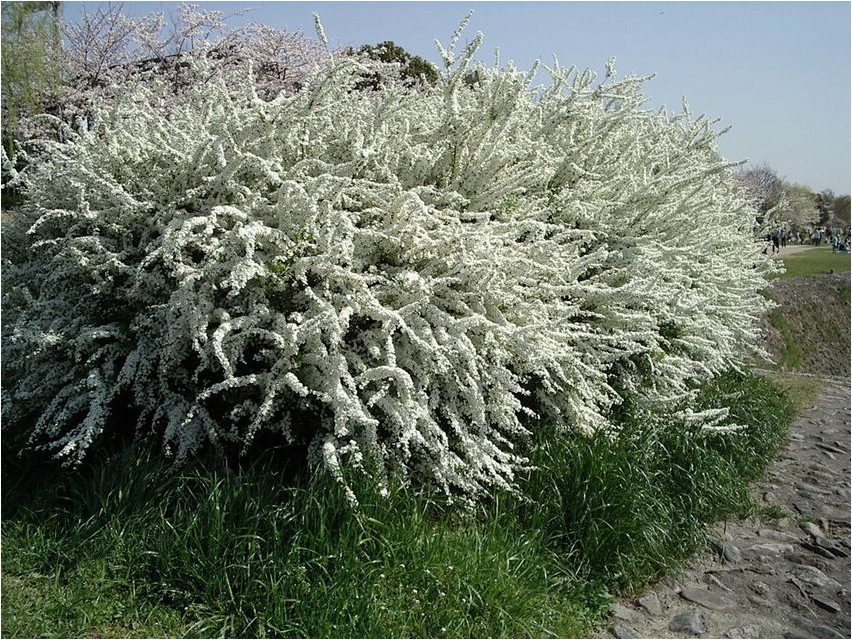
Spiraea (Latin: Spiraea) is a spectacular ornamental shrub belonging to the Rosaceae family.
Description
Spiraea is an ornamental and deciduous shrub, ranging in height from fifteen centimeters to two and a half meters. The rhizomes of this plant are shallow and usually fibrous. The spreading, erect branches, with bark peeling longitudinally, can be prostrate, ascending, or recumbent, and their color ranges from light to dark brownish. Young shoots are pubescent or bare and can boast brown, slightly reddish, yellowish, or green coloration.
The shape of the petiolate and stipulate-less leaves can vary from round to a whimsical lanceolate-linear. All leaflets are doubly serrate or simply serrate and three- or five-lobed. The inflorescences of spring-blooming spirea are sessile or nearly sessile umbels or magnificent corymbose racemes with leaf rosettes located near the base. Summer-blooming varieties have inflorescences arranged in complex or simple corymbs, located at the tips of shoots or short leafy branches. Late-blooming varieties typically have inflorescences in broadly pyramidal, elliptical, or narrowly cylindrical panicles located at the tips of long leafy shoots.
Spirea flowers are typically bisexual, although dioecious specimens are occasionally encountered. Spring-blooming varieties typically have white flowers, summer-blooming varieties range in color from white to pinkish-red, and late-blooming varieties boast luxurious purple hues (with rare exceptions). All flowers have five petals—they are oblong yet slightly rounded, and their length exceeds that of the sepals.
Spiraea fruits are multi-seeded leaflets that open first along the inner suture and then along the outer suture. The brownish, winged, lanceolate, and rather flat seeds reach 0. 5 mm in width and range from one and a half to two millimeters in length.
Where it grows

Spiraea is found primarily in the Northern Hemisphere. In North America, its distribution range extends through Mexico, and in Asia, through the Himalayas.
Varieties
Japanese spirea. It is an incredibly spectacular shrub, the young shoots of which are always tomentose, and the old shoots are bare. The height of these bushes ranges from one to one and a half meters, and their ovate-oblong leaves are green on top and bluish below. And such spirea blooms with amazingly beautiful reddish-pinkish flowers collected in paniculate-corymbose inflorescences.
Spiraea arguta. These spreading bushes from one and a half to two meters in height boast a rather unusual shape — their flowering drooping branches are very reminiscent of a foamy waterfall flowing along their entire length, formed by a huge number of fragrant snow-white flowers.
Spiraea Douglas. Behind this name lies a one and a half meter bush, endowed with pubescent and straight shoots of reddish-brownish shades. The length of its oblong-lanceolate leaves ranges from three to ten centimeters, and luxurious dark pink flowers form narrow apical inflorescences of a paniculate-pyramidal shape.
Application
Spiraea has long been used in forestry, landscaping, ornamental gardening and the creation of luxurious hedges. It has proven itself quite well as a soil strengthening plant. Among other things, many varieties of spirea are excellent honey plants and valuable sources of highly effective medicinal raw materials.
The most unpretentious shrub — spirea