Sedum
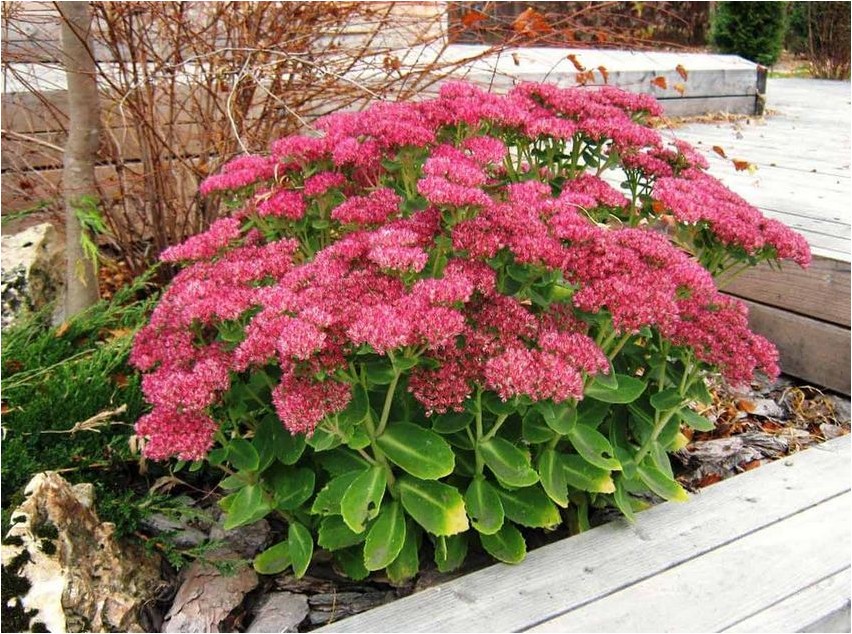
Sedum (lat. Sedum) is a drought-resistant perennial from the Crassulaceae family. Its second name is sedum.
Description
Sedum is a herbaceous succulent annual or perennial subshrub, which can be either ground-based or creeping.
The leaves of the sedum can be either pubescent or glabrous, either finely toothed at the edges or entire. They are endowed with the ability to grow very quickly and often hibernate. And the shape, color and size of these leaves can be as varied as desired.
Small sedum flowers are collected in incredibly attractive corymbose inflorescences, although occasionally single specimens are found. These flowers can be red, pink, yellow or white, and their bloom can be admired from June to September.
In total, the genus Sedum has about six hundred and fifty species.
Where does it grow
Most often, sedum can be found in the Northern Hemisphere, in its temperate zones.

Usage
More than a dozen varieties of sedum are quite actively used in culture: these are evergreen varieties, thicket-forming plants, and creeping specimens. Moreover, this plant is used mainly not for its flowers, but for its luxurious foliage — its variously colored leaves with a very unusual structure boast impressive decorative properties. However, the flowers of some varieties of sedum are also stunningly beautiful!
Sedum will look best in rock gardens — its beauty against the background of stones is revealed in full force and enhanced significantly. This plant is just as suitable for decorating borders, ridges and carpet compositions; in addition, it has proven itself very well in landscaping slopes. And tall varieties will look great in groups or mixborders.
Growing and care
Sedum is very light-loving, so it should be planted exclusively in the light. The color of the leaves of this plant in the sun will be even more juicy and bright, moreover, some leaves may even acquire the effect of a tan or a slight blush!
The most preferable soils for growing sedum will be poor, dry soils — sandy or rocky. But garden soils are also perfect for these purposes. At the same time, some varieties will grow well only in moist soils, others can boast greater drought resistance, and still others can easily tolerate even too severe drought. But none of these plants can tolerate soaking (in other words, lack of drainage), and this fact should not be discounted in any case!
In general, sedum is quite unpretentious in care; in addition, this plant is characterized by fairly high frost resistance.
Sedum is propagated mainly by seeds, however, it is quite possible to propagate it vegetatively — either by stem cuttings throughout the summer, or by dividing bushes in the spring or towards the end of the summer season. At the same time, it is important to try to place the sedum plantings in such a way that in the autumn they are not covered by falling leaves from the trees — the layer of leaf litter with the onset of spring, the sedum, alas, will not be able to break through.
And since the sedum is subject to loss or growth, every three to six years this plant should be divided or simply recutted. This approach will help maintain even picturesque carpets.
By the way, species plants will take root best, but sometimes you have to tinker with hybrids, varieties and decorative forms.