Mahonia
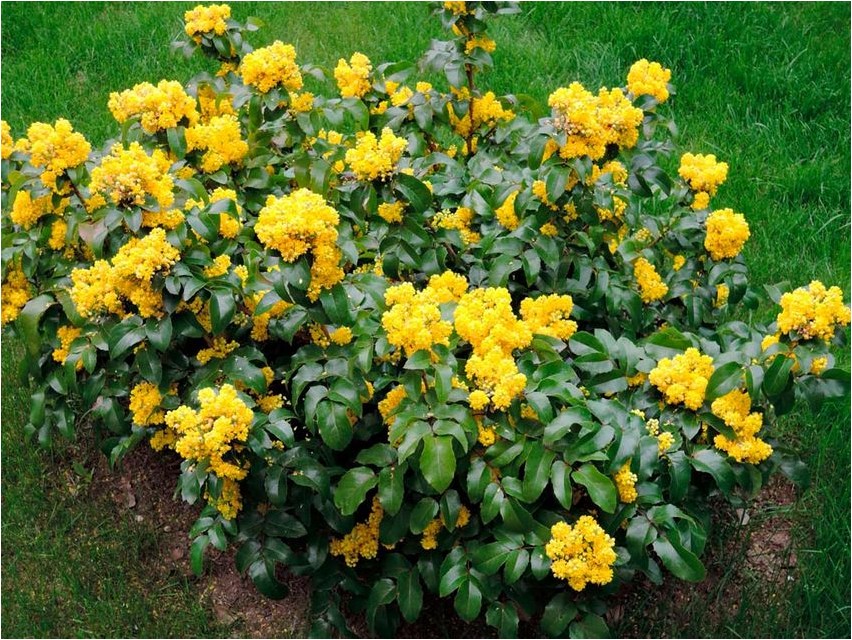
Mahonia (lat. Mahonia) is an ornamental shrub of the Barberry family. In the wild, mahonias are found in North and Central America, South and East Asia.
The plant was named after Bernard McMahon, an American gardener of Irish descent. Currently there are about 50 species.
Characteristics of culture
Mahonia is an evergreen shrub or small tree with gray bark. The leaves are compound, odd-pinnate, leathery with a shine, with or without stipules, sharply toothed at the edges, arranged alternately, and can reach 40 cm in length. The flowers are small, yellow, collected in multi-flowered panicles or erect inflorescences.
The fruit is a spherical or oval berry, it can be black-blue, blue or red with a bluish bloom; there are forms with white fruit. In Russia, one species has become widespread — Mahonia aquifolia.
Growing conditions

Mahonia is a heat-loving plant that prefers slightly shaded areas. The crop has a negative attitude towards direct sunlight, but grows in such conditions of high soil moisture. Prolonged drought and high temperatures have a detrimental effect on the development of mahonia. Soils for growing shrubs are preferably loose, fertile, moderately moist, drained with a neutral pH reaction. Too compacted, swampy, saline and dry soils are not suitable for growing crops.
Reproduction and planting
Mahonias are propagated by seeds, layering, cuttings and grafting. Sowing is carried out in the fall, although spring sowing is not prohibited. Seeds are subjected to long-term stratification before sowing. This method of propagating mahonia takes a long time and is not effective; young plants bloom only after 4-5 years. Most often, gardeners propagate the crop by layering and cuttings. Cuttings are cut only from young shrubs; cuttings taken from old mahonias do not take root.
Mahonia seedlings are planted in spring or autumn. Planting holes are prepared in advance. The depth of the hole should be 40-50 cm, and the width — 50-55 cm. The soil removed from the hole is mixed with humus and sand. Drainage in the form of crushed stone and 1/3 of the soil mixture are poured into the bottom of the hole. When planting, it is important to ensure that the root collar of the seedling is located at soil level. The distance between plants should be at least 1 m, for free growth — 2 m. After planting, the plants are watered and mulched with peat.
Care
Mahonia is moisture-loving and needs regular watering, at least once every two weeks, 10-12 liters per bush. Watering is carried out not only at the root; it is advisable to irrigate the plants from a hose with a diffuser. This procedure will not only clean the pores of the leaves, but will also give the mahonia a fresh and attractive look.
He responds positively to fertilizing the crop. Fertilizers are applied twice per season: the first fertilizing with complex mineral fertilizers is carried out before flowering, the second fertilizing is carried out in the fall. When the soil is compacted near the tree trunks, loosening is carried out, this way you can provide additional air flow to the root system.
Mahonia tolerates pruning well and recovers quickly. Pruning is done immediately after flowering or in late autumn. Flower buds next spring will form on last year”s growth, so the shoots are shortened by a maximum of half. In some cases, plants are pruned “to the stump” (this applies to old specimens and shrubs with a severely deformed crown), there is no need to worry, mahonia will quickly recover and easily form a beautiful crown.
Application
Mahonia is a highly ornamental plant that fits perfectly into various garden compositions. Low-growing forms will decorate rocky gardens and borders. Mahonias are often used to create hedges. The crop is planted in groups on the lawn. Mahonias go well with roses and look harmonious in mixed compositions with perennial flower crops and flowering shrubs.





