Hellebore black
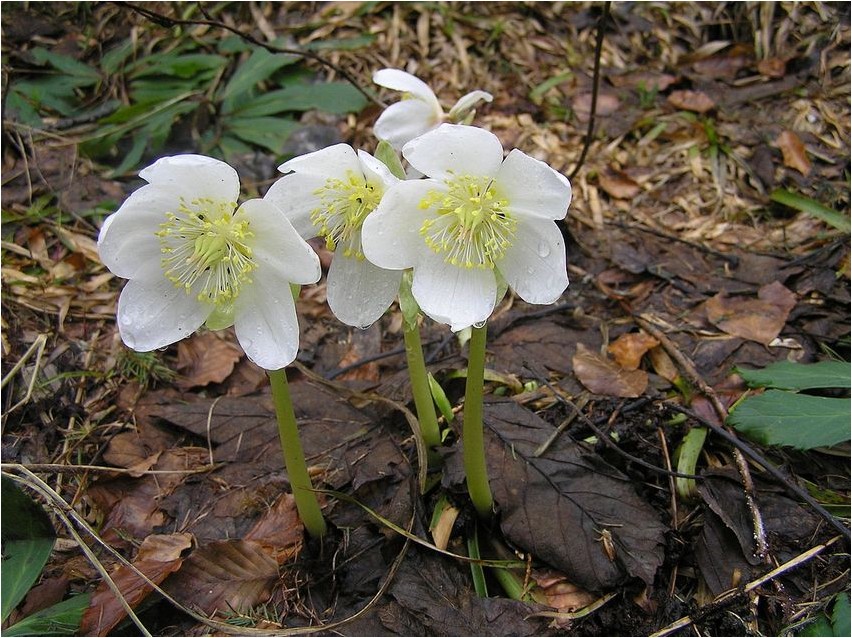
Black hellebore is one of the plants of the family called Ranunculaceae; in Latin the name of this plant will be as follows: Helleborus niger L.
As for the name of the black hellebore family itself, in Latin it will be: Ranunculaceae Juss.
Description of black hellebore
Black hellebore is a perennial herbaceous plant whose height will vary between fifteen and thirty centimeters. The basal leaves of this plant are quite large, they will be on long petioles, and will also be stop-shaped and dissected into five to seven leaflets, and the length of such leaves will be about ten to fifteen centimeters. The leaves of the black hellebore will be shiny and smooth on top, and pubescent underneath, while the edges will be double serrated. The flowering shoots of this plant turn out to be quite low; they are endowed with one to three drooping large flowers, which are about three and a half to five centimeters in diameter. The sepals of the black hellebore are colored on the outside in dirty violet-purple tones and are endowed with dark veins, as well as a stronger edging of the edge, while the nectary petals of this plant are colored in yellow-green tones. At the very base, the leaves of this plant are fused, they will be quite large in size, and are also endowed with a sharp keel located on the outer side.
Black hellebore blooms from February to April. Under natural conditions, this plant is found in the Dnieper region in Ukraine and in the Baltic region of the European part of Russia. This plant prefers deciduous forests to grow. It is worth noting that black hellebore is not only an ornamental plant, but also a very valuable honey plant. This plant is also poisonous, for this reason it is important to exercise extreme caution when handling this plant.
Description of the medicinal properties of black hellebore
Black hellebore is endowed with very valuable healing properties. The presence of such medicinal properties should be explained by the content of sapogenin, gamma-lactone ranuncoside, steroid ecdysterone and bufadienolide gellibrine in this plant. The following flavonoids will be present in the petals and stamens of black hellebore: quercetin glycoside and kaempferol.
It should be noted that in homeopathy, the roots and rhizomes of this plant are quite widespread for various nervous diseases and meningitis. As for Indian medicine, black hellebore is used as a very effective heart remedy. Locally, this plant is used as a pain reliever, and is also used for various skin diseases and strokes. Sometimes black hellebore bark is used for various cancer diseases.

For cancer, the following remedy based on this plant is considered very effective: to prepare such a very healing remedy, you will need to take half a teaspoon of crushed bark of the roots of black hellebore in two cups of boiling water. It is recommended to infuse the resulting healing mixture for about two hours, after which it is very important to carefully strain such a medicinal mixture based on this plant. Take this healing remedy based on black hellebore three times a day, one tablespoon for a month. However, it should be noted that, if necessary, it is quite acceptable to repeat a similar course after two weeks.





